
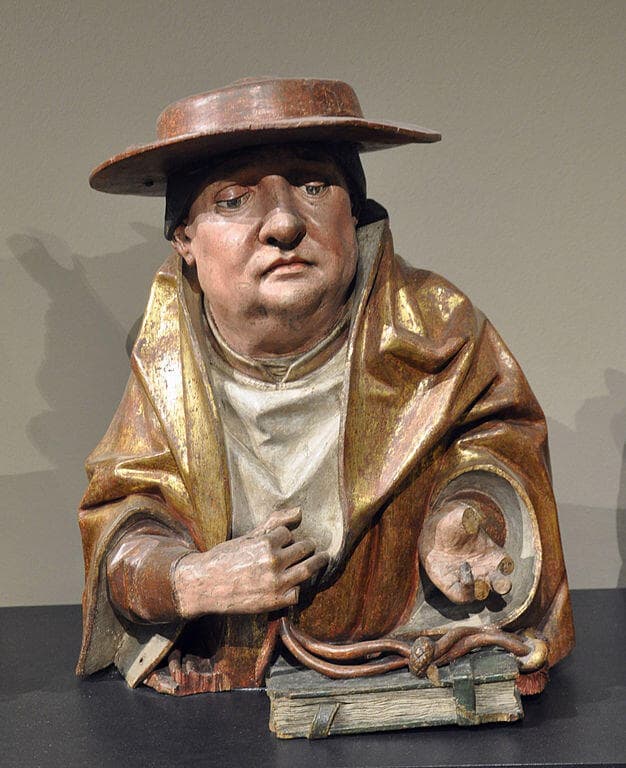
Jerome
Catena Aurea · Matthäusevangelium 27
Now from the sixth hour there was darkness over all the land unto the ninth hour. And about the ninth hour Jesus cried with a loud voice, saying, Eli, Eli, lama sabachthani? that is to say, My God, may God, why hast thou forsaken me? Some of them that stood there, when they heard that, said, This man calleth for Elias. And straightway one of them ran, and took a spunge, and filled it with vinegar, and put it on a reed, and gave him to drink. The rest said, Let be, let us see whether Elias will come to save him. Jesus, when he had cried again with a loud voice, yielded up the ghost. PSEUDO-DIONYSIUS. (ad Polycarp. Ep. 7.) When we were together at Heliopolis, we both observed such an interference of the moon with the sun quite unexpectedly, for it was not the season of their conjunction; and then from the ninth hour until evening, beyond the power of nature, continuing in a direct line between us and the sun. And this obscuration we saw begin from the east, and so pass to the extreme of the sun’s orb, and again return back the same way, being thus the very reverse of an ordinary eclipse.
He employed the beginning of the twenty-first Psalm. (Ps. 22:1. Vulg.) That clause in the middle of the verse, Look upon me, is superfluous; for the Hebrew has only ‘Eli, Eli, lama sabachthani,’ that is, My God, my God, why hast thou forsaken me? It is impiety therefore to think that this Psalm was spoken in the character of David or Esther or Mardocheus, when passages taken out of it by the Evangelist are understood of the Saviour; as, They parted my garments among them, and, They pierced my hands.