
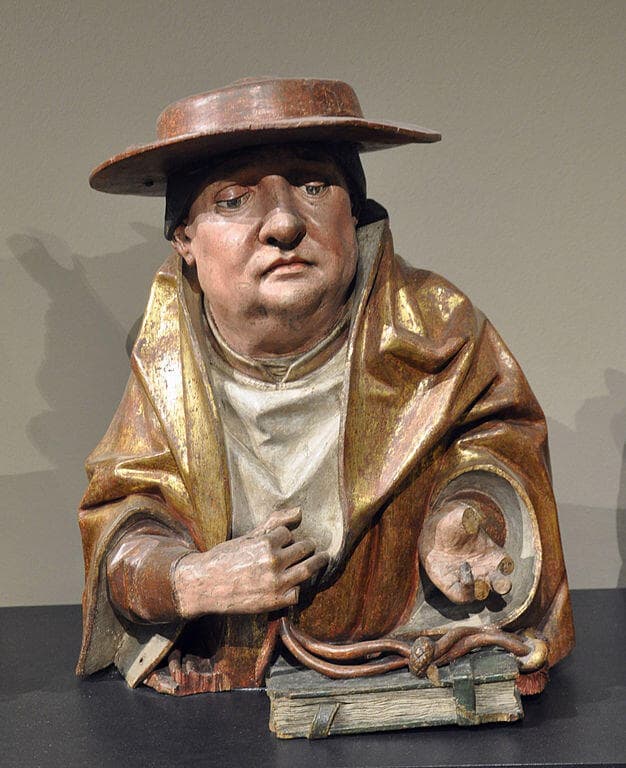
Jerome
Catena Aurea · Matthäusevangelium 22
The same day came to him the Sadducees, which say that there is no resurrection, and asked him, Saying, Master, Moses said, If a man die, having no children, his brother shall marry his wife, and raise up seed unto his brother. Now there were with us seven brethren: and the first, when he had married a wife, deceased, and, having no issue, left his wife unto his brother: Likewise the second also, and the third, unto the seventh. And last of all the woman died also. Therefore in the resurrection whose wife shall she be of the seven? for they all had her. Jesus answered and said unto them, Ye do err, not knowing the Scriptures, nor the power of God. For in the resurrection they neither marry, nor are given in marriage, but are as the angels of God in heaven. But as touching the resurrection of the dead, have ye not read that which was spoken unto you by God, saying, I am the God of Abraham, and the God of Isaac, and the God of Jacob? God is not the God of the dead, but of the living. And when the multitude heard this, they were astonished at his doctrine. PSEUDO-DIONYSIUS. (de Divin. Nom. i.) For then when we shall be incorruptible and immortal, by the visible presence of God Himself we shall be filled with most chaste contemplations, and shall share the gift of light to the understanding in our impassible and immaterial soul after the fashion of the exalted souls in heaven; on which account it is said that we shall be equal to the Angels.
In proof of the resurrection there were many plainer passages which He might have cited; among others that of Isaiah, The dead shall be raised; they that are in the tombs shall rise again: (Is. 26:19. juxta LXX.) and in another place, Many of them that sleep in the dust of the earth shall awake. (Dan. 12:2.) It is enquired therefore why the Lord should have chosen this testimony which seems ambiguous, and not sufficiently belonging to the truth of the resurrection; and as if by this He had proved the point adds, He is not the God of the dead, but of the living. We have said above that the Sadducees confessed neither Angel, nor spirit, nor resurrection of the body, and taught also the death of the soul. But they also received only the five books of Moses, rejecting the Prophets. It would have been foolish therefore to have brought forward testimonies whose authority they did not admit. To prove the immortality of souls therefore, He brings forward an instance out of Moses, I am the God of Abraham, &c. and then straight subjoins, He is not the God of the dead, but of the living; so that having established that souls abide after death,(forasmuch as God could not be the God of those who had no existence any where,) there might fitly come in the resurrection of bodies which had together with their souls done good or evil.