
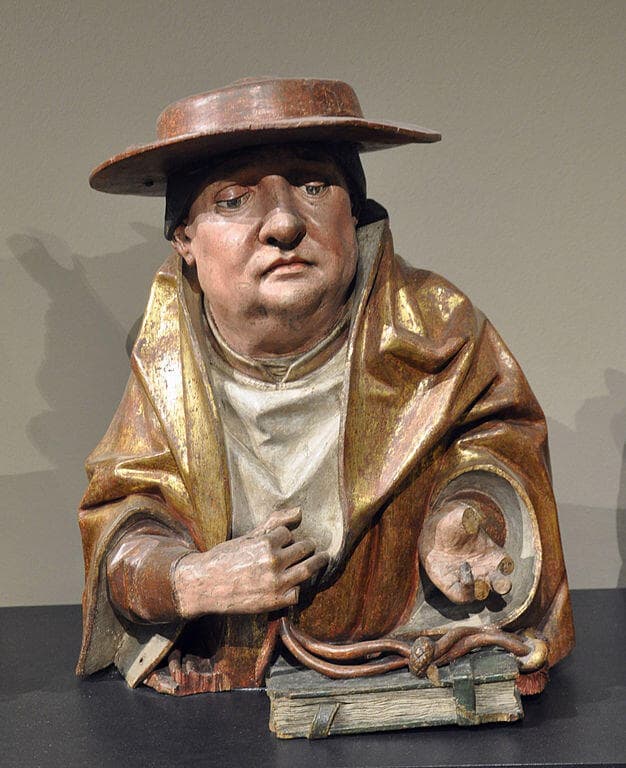
Jerome
Catena Aurea · Matthäusevangelium 12
While he yet talked to the people, behold, his mother and his brethren stood without, desiring to speak with him. Then one said unto him, Behold, thy mother and thy brethren stand without, desiring to speak with thee. But he answered and said unto him that told him, Who is my mother? and who are my brethren? And he stretched forth his hand toward his disciples, and said, Behold my mother and my brethren! For whosoever shall do the will of my Father which is in heaven, the same is my brother, and sister, and mother.
(cont. Helvid. 14, et seq.) From this is taken one of Helvidius’s propositions, on the ground that mention is made in the Gospel of the brethren of the Lord. How, says he, are they called brethren of the Lord, if they were not his brethren? But now it should be known that in divine Scripture men are said to be brethren in four different ways, by nature, by nation, by kindred, and by affection. By nature, as Esau and Jacob. By nation, as all Jews are called brethren, as in Deuteronomy, Thou shalt not set over thee a foreigner who is not thy brother. (Deut. 17:15) They are called brethren by kindred who are of one family, as in Genesis, Abraham said unto Lot, Let there not be strife between thee and me, for we are brethren. (Gen. 13:8) Also men are called brethren by affection, which is of two kinds, special and general. Special, as all Christians are called brethren, as the Saviour says, Go tell my brethren. General, inasmuch as all men are born of one father, we are bound together by a tie of consanguinity, as in that, Say unto them that hate you, Ye are our brethren. (Is. 66:5 sec. LXX.) I ask then, after which manner these are called the Lord’s brethren in the Gospel? According to nature? But Scripture saith not, neither calling them sons of Mary nor of Joseph. By nation? But it is absurd that some few out of all the Jews should be called brethren, seeing that all the Jews who were there might have thus been called brethren. By affection, either of a human sort, or of the Spirit? If that be true, yet how were they more His brethren than the Apostles, whom He instructed in the inmost mysteries. Or if because they were men, and all men are brethren, it was foolish to say of them in particular, Behold, thy brethren seek thee. It only remains then that they should be His brethren by kindred, not by affection, not by privilege of nation, not by nature.