
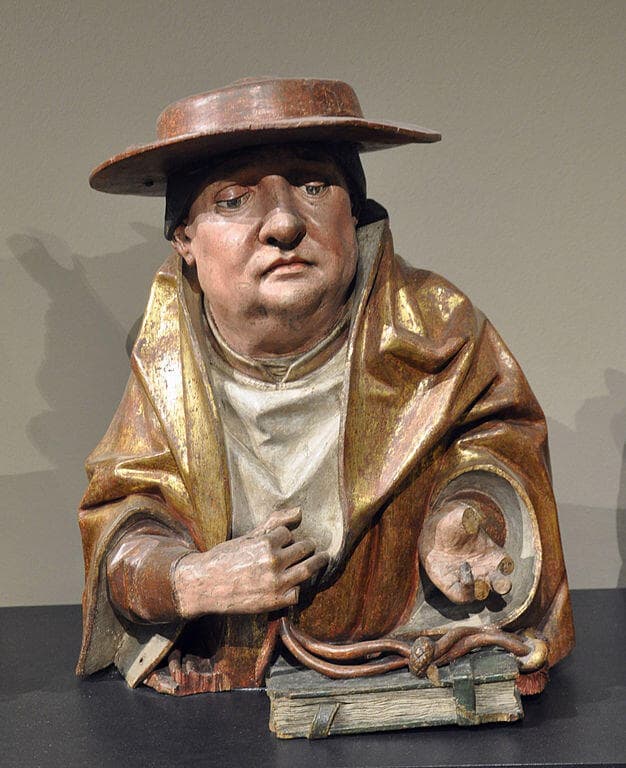
Jerome
Catena Aurea · Matthäusevangelium 1
Now all this was done, that it might be fulfilled which was spoken of the Lord by the prophet, saying, Behold, a Virgin shall be with child, and shall bring forth a Son, and they shall call His Name Emmanuel, which being interpreted is, God with us. Here we must enquire why he should say all this was done, when above he has only related the conception. It should be known that he says this to shew, that in the presence of God all this was done before it was done among men. Or he says, all this was done, because he is relating past events; for when he wrote, it was all done.
(In Is. 7:14.) Since it is introduced in the Prophet by the words, The Lord Himself shall give you a sign, it ought to be something new and wonderful. But if it be, as the Jews will have it, a young woman, or a girl shall bring forth, and not a virgin, what wonder is this, since these are words signifying age and not purity? Indeed the Hebrew word signifying Virgin (Bethula) is not used in this place, but instead the word ‘Halmaa,’ which except the LXX all render ‘girl.’ But the word ‘Halma’ has a twofold meaning; it signifies both ‘girl,’ and ‘hidden;’ therefore ‘Halma’ denotes not only ‘maiden’ or ‘virgin,’ but ‘hidden,’ ‘secret;’ that is, one never exposed to the gaze of men, but kept under close custody by her parents. In the Punic tongue also, which is said to be derived from Hebrew sources, a virgin is properly called ‘Halma.’ In our tongue also ‘Halma’ means holy; and the Hebrews use words of nearly all languages; and as far as my memory will serve me, I do not think I ever met with Halma used of a married woman, but of her that is a virgin, and such that she be not merely a virgin, but in the age of youth; for it is possible for an old woman to be a maid. But this was a virgin in years of youth, or at least a virgin, and not a child too young for marriage.