
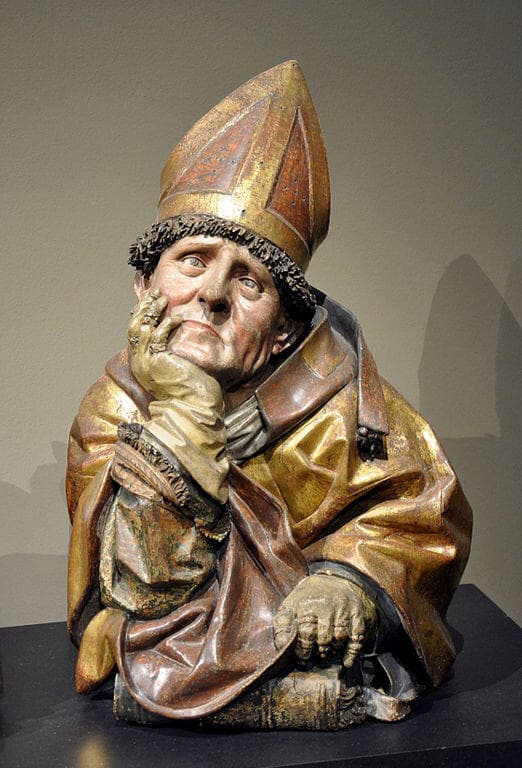
Augustine of Hippo
Catena Aurea · Markusevangelium 10
And he arose from thence, and cometh into the coasts of Judæa by the farther side of Jordan: and the people resort unto him again; and, as he was wont, he taught them again. And the Pharisees came to him, and asked him, Is it lawful for a man to put away his wife? tempting him. And he answered and said unto them, What did Moses command you? And they said, Moses suffered to write a bill of divorcement, and to put her away. And Jesus answered and said unto them, For the hardness of your heart he wrote you this precept. But from the beginning of the creation God made them male and female. For this cause shall a man leave his father and mother, and cleave to his wife; And they twain shall be one flesh: so then they are no more twain, but one flesh. What therefore God hath joined together, let not man put asunder. And in the house his disciples asked him again of the same matter. And he saith unto them, Whosoever shall put away his wife, and marry another, committeth adultery against her. And if a woman shall put away her husband and be married to another, she committeth adultery.
(cont. Faust. xix. 26) Moses, however, was against a man’s dismissing his wife, for he interposed this delay, that a person whose mind was bent on separation, might be deterred by the writing of the bill, and desist; particularly, since, as is related, among the Hebrews, no one was allowed to write Hebrew characters but the scribes. The law therefore wished to send him, whom it ordered to give a bill of divorcement, before he dismissed his wife, to them, who ought to be wise interpreters of the law, and just opponents of quarrel. For a bill could only be written for him by men, who by their good advice might overrule him, since his circumstances and necessity had put him into their hands, and so by treating between him and his wife they might persuade them to love and concord. But if a hatred so great had arisen that it could not be extinguished and corrected, then indeed a bill was to be written, that he mightnot lightly put away her who was the object of his hate, in such a way as to prevent his being recalled to the love, which he owed her by marriage, through the persuasion of the wise. For this reason it is added, For the hardness of your heart, he wrote this precept; for great was the hardness of heart which could not be melted or bent to the taking back and recalling the love of marriage, even by the interposition of a bill in a way which gave room for the just and wise to dissuade them.