
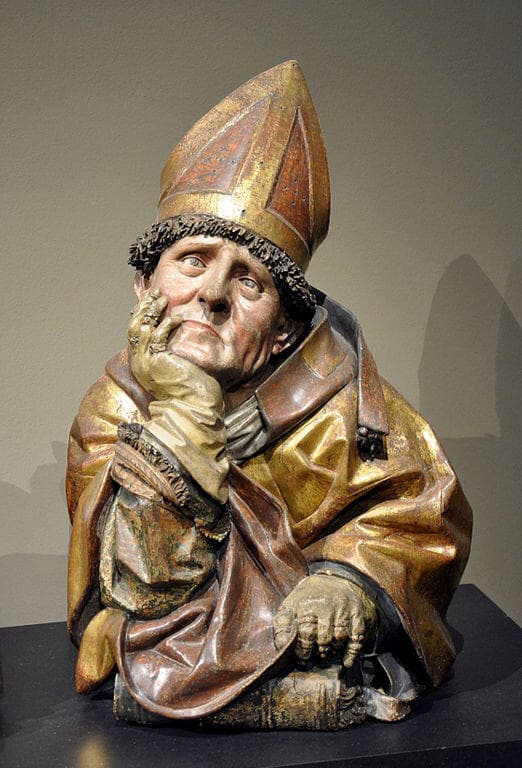
Augustine of Hippo
Catena Aurea · Markusevangelium 10
And he arose from thence, and cometh into the coasts of Judæa by the farther side of Jordan: and the people resort unto him again; and, as he was wont, he taught them again. And the Pharisees came to him, and asked him, Is it lawful for a man to put away his wife? tempting him. And he answered and said unto them, What did Moses command you? And they said, Moses suffered to write a bill of divorcement, and to put her away. And Jesus answered and said unto them, For the hardness of your heart he wrote you this precept. But from the beginning of the creation God made them male and female. For this cause shall a man leave his father and mother, and cleave to his wife; And they twain shall be one flesh: so then they are no more twain, but one flesh. What therefore God hath joined together, let not man put asunder. And in the house his disciples asked him again of the same matter. And he saith unto them, Whosoever shall put away his wife, and marry another, committeth adultery against her. And if a woman shall put away her husband and be married to another, she committeth adultery.
(de Con. Evan. 2. 62) It makes nothing, however, to the truth of the fact, whether, as Matthew says,1 they themselves addressed to the Lord the question concerning the bill of divorcement, allowed to them by Moses, on our Lord’s forbidding the separation, and confirming His sentence from the law, or whether it was in answer to a question of His, that they said this concerning the command of Moses, as Mark here says. For His wish was to give them no reason why Moses permitted it, before they themselves had mentioned the fact; since then the wish of the parties speaking, which is what the words ought to express, is in either way shewn, there is no discrepancy, though there be a difference in the way of relating it. It may also be meant that, as Mark expresses it, the question put to them by the Lord, What did Moses command? was in answer to those who had previously asked His opinion concerning the putting away of a wife; and when they had replied that Moses permitted them to write a bill of divorcement, and to put her away, (Matt. 19:4) His answer was concerning that same law, given by Moses, how God instituted the marriage of a male, and a female, saying those things which Matthew relates; on hearing which they again rejoined what they had replied to Him when He first asked them, namely, Why then did Moses command?