
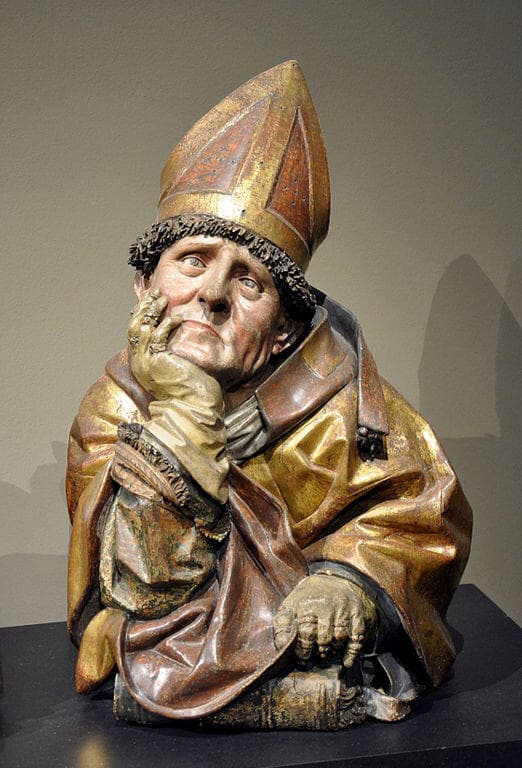
Augustine of Hippo
Catena Aurea · Johannesevangelium 13
Now before the feast of the passover, when Jesus knew that his hour was come that he should depart out of this world unto the Father, having loved his own which were in the world, he loved them unto the end. And supper being ended, the devil having now put into the heart of Judas Iscariot, Simon’s son, to betray him; Jesus knowing that the Father had given all things into his hands, and that he was come from God, and went to God; He riseth from supper, and laid aside his garments; and took a towel, and girded himself. After that he poureth water into a bason, and began to wash the disciples’ feet, and to wipe them with the towel wherewith he was girded.
(Tr. lv) Pascha is not a Greek word, as some think, but Hebrew: though there is remarkable agreement of the two languages in it. The Greek word to suffer being πασχεῖν, pascha has been thought to mean passion, as being derived from the above word. But in Hebrew, pascha is a passing over; the feast deriving its name from the passing of the people of God over the Red Sea into Egypt. All was now to take place in reality, of which that passover was the type. Christ was led as a lamb to the slaughter; whose blood sprinkled upon our door-posts, i. e. whose sign of the cross marked on our foreheads, delivers us from the dominion of this world, as from Egyptian bondage. And we perform a most wholesome journey or pass-over, when we pass over from the devil to Christ, from this unstable world to His sure kingdom. In this way the Evangelist seems to interpret the word: When Jesus knew that His hour was come when He should pass over1 out of this world unto the Father. This is the pascha, this the passing over.