Seite wird geladen …
Messbund der Priesterbruderschaft St. Petrus · Für Mitglieder dieses Bunds werden regelmäßig heilige Messen im Priesterseminar St. Petrus gefeiert.
AnsehenSeite wird geladen …
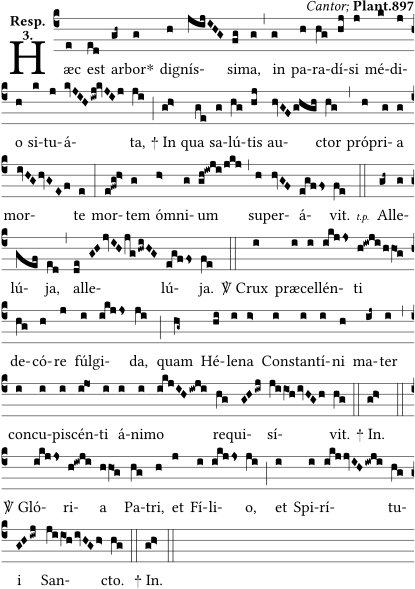
Gregorianischer Choral
"(c4) H\u00e6c(e) est(ed) ar(gh~)bor<sp>*</sp>(g) di(h)gn\u00eds(jijIHG)si(fg)ma,(g) (,)\r\nin(g) pa(h)ra(hg)d\u00ed(hj)si(j) m\u00e9(k)di(j)o(h) si(k)tu(j)\u00e1(kvJIHiwj!kvJIj)ta,(ji) (;)\r\n<sp>+</sp> In(gh>) qua(ge) sa(g)l\u00fa(hg)tis(hj) au(hvGFghgh)ctor(hg) (,)\r\npr\u00f3(h)pri(g)a(g) mor(ivHGhvGEf)te(e) (:)\r\nmor(e!fwg!h>)tem(g) \u00f3(h>)mni(g)um(gh!iwji/jkj) (,)\r\nsu(h)per(hvGF)\u00e1(egfFs)vit.(fe) (::)\r\n<v>{\\scriptsize\\itshape t.p.\\ }</v> Al(gh~)le(g)l\u00fa(gef)ja,(ed) (,) \r\nal(de)le(GHjvIHjg/hwiHG)l\u00fa(egfFs)ja.(fe) (::)\r\n<sp>V/</sp> Crux(i) pr\u00e6(i)cel(i)l\u00e9n(ikjJs)ti(h!iwji/hhO1g) de(hg)c\u00f3(h)re(j) f\u00fal(i)gi(ikjJs)da,(ji) (;)\r\nquam(hg~) H\u00e9(hi)le(i)na(i>) Con(i)stan(i)t\u00ed(i)ni(h) ma(ij~)ter(i) (,)\r\ncon(i)cu(i)pi(i)sc\u00e9n(i!jo1)ti(i) \u00e1(i)ni(i)mo(ikjIHiwji) re(hg)qui(GHiwj)s\u00ed(jiiO1hivHGh)vit.(hg) (::)\r\n<sp>+</sp> In.(gh>) (::)\r\n<sp>V/</sp> Gl\u00f3(ikjjs)ri(h!iwji)a(hhO1!g) Pa(hg)tri,(h) et(j) F\u00ed(i)li(ikjjs)o,(ji) (;) \r\net(i) Spi(i)r\u00ed(ikjjvIHiwji)tu(hg)i(GHiwj) San(jiiO1hivHGh>)cto.(hg) (::)\r\n<sp>+</sp> In.(gh>) (::)\r\n"Mit diesem GABC Code kann der Choral z.B. mit gerendert werden.
„Tertius mysticus (Der Dritte ist mystisch)“
Der 3. Ton (Phrygisch) wird oft als mystisch, streng oder stürmisch beschrieben.