Seite wird geladen …
Gratisschriften zum katholischen Glauben — Nimm und lies! · Die aufgeführten Schriften besitzen die kirchliche Druckerlaubnis. Sie eignen sich für Schriftenstände, den Unterricht und die Katechese sowie für jede Form von Apostolat.
AnsehenSeite wird geladen …
Gregorianischer Choral
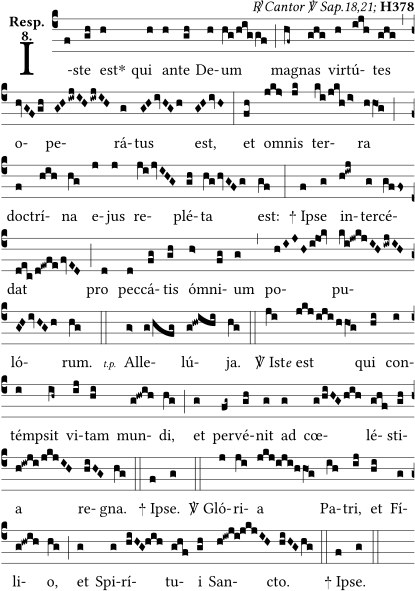
"(c4) I(f)ste(gh) est<sp>*</sp>(h) qui(h) an(h)te(gh) De(h)um(hg/higgf) (;)\r\nma(hf~)gnas(ghg) vir(h)t\u00fa(ijh)tes(ghg) (,)\r\no(hvGFgh)pe(GHiwjIHiwjIH)r\u00e1(g)tus(GHivHGh) est,(GHivH) (:)\r\net(fh) o(jkj>)mnis(jk) ter(ki/jkh/i>)ra(hhO1g) (;)\r\ndo(f)ctr\u00ed(hih)na(hg) e(j)jus(j) re(ji/jvIHG)pl\u00e9(gh)ta(hghvGFg) est:(gf) (:)\r\n<sp>+</sp> I(f)pse(g) in(h!iwj)ter(g)c\u00e9(gfFs)dat(dec/d!ewfefvED) (;)\r\npro(d) pec(d)c\u00e1(fg)tis(gh) \u00f3(h>)mni(fg)um(g) (,)\r\npo(hI2J2H2i!jo1!kv)pu(ki!jwkjIHiwjIH)l\u00f3(GHivHGh)rum.(hg) (::)\r\n<v>{\\scriptsize\\itshape t.p.\\ }</v> Al(g>)le(g/hfg)l\u00fa(g!hwihi)ja.(hg) (::)\r\n<sp>V/</sp> I(ji)st<e>e</e> est(jkj/iji/hhO1g) qui(hi) con(i)t\u00e9m(i)psit(ih~) vi(ij)tam(hi) mun(g!hwih)di,(hg) (;)\r\net(g) per(fg~)v\u00e9(gh)nit(g) ad(g) c\u0153(g/hiHGhih)l\u00e9(ghf)sti(gh)a(h!iwji/jkjIH) re(hiHG)gna.(hg) (::)\r\n<sp>+</sp> I(f)pse.(g) (::) %error in source\r\n<sp>V/</sp> Gl\u00f3(j)ri(ji)a(jkj/0iji/0hhO1g) Pa(ih)tri,(ij) et(hi) F\u00ed(g)li(g@hwih)o,(hg) (;) \r\net(g) Spi(g)r\u00ed(hiHG@hih)tu(ghf)i(gh) San(h@iwji@jkjIH)cto.(hiHG/hg) (::)\r\n<sp>+</sp> I(f)pse.(g) (::) %error in source\r\n"Mit diesem GABC Code kann der Choral z.B. mit gerendert werden.
„Octavus perfectus (Der Achte ist vollkommen)“
Der 8. Ton (Hypomixolydisch) wird als weise, würdevoll und vollkommen beschrieben.