Seite wird geladen …
Die überlieferte Lateinische Messe weltweit finden · Alle Messen, die gemäß den 1962 geltenden liturgischen Büchern gefeiert werden, mit Zustimmung der Bischöfe der katholischen Kirche und des Heiligen Stuhls unter der Leitung von Papst Leo XIV.
AnsehenSeite wird geladen …
Gregorianischer Choral
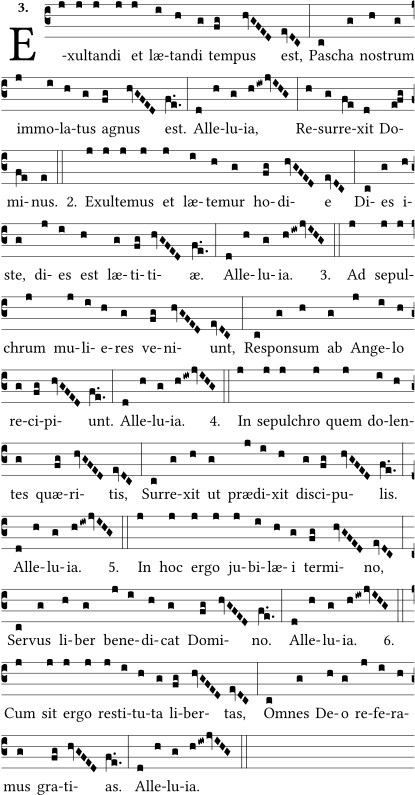
"E(j)xul(j)tan(j)di(j) et(j) l\u00e6(i)tan(h)di(g) tem(fg)pus(hvGFED) est,(evDC) (:)\r\nPas(c)cha(g) no(h)strum(g) im(j)mo(i)la(h)tus(g) a(fg)gnus(hvGFED) est.(f.e.) (:) Al(d)le(h)lu(g)ia,(hiwjvIHG) (:) Re(h)sur(g)re(fe)xit(d) Do(efg)mi(fe)nus.(e) (::)\r\n \r\n2.() E(j)xul(j)te(j)mus(j) et(j) l\u00e6(i)te(h)mur(g) ho(fg)di(hvGFED)e(evDC) (:)\r\nDi(c)es(g) i(h)ste,(g) di(j)es(i) est(h) l\u00e6(g)ti(fg)ti(hvGFED)\u00e6.(f.e.) (:) Al(d)le(h)lu(g)ia.(hiwjvIHG) \r\n\r\n3.(::) Ad(j) se(j)pul(j)chrum(j) mu(j)li(i)e(h)res(g) ve(fg)ni(hvGFED)unt,(evDC) (:)\r\nRe(c)spon(g)sum(h) ab(g) An(j)ge(i)lo(h) re(g)ci(fg)pi(hvGFED)unt.(f.e.) (:) Al(d)le(h)lu(g)ia.(hiwjvIHG) \r\n\r\n4.(::) In(j) se(j)pul(j)chro(j) quem(j) do(i)len(h)tes(g) qu\u00e6(fg)ri(hvGFED)tis,(evDC) (:)\r\nSur(c)re(g)xit(h) ut(g) pr\u00e6(j)di(i)xit(h) di(g)sci(fg)pu(hvGFED)lis.(f.e.) (:) Al(d)le(h)lu(g)ia.(hiwjvIHG) \r\n\r\n5.(::) In(j) hoc(j) er(j)go(j) ju(j)bi(i)l\u00e6(h)i(g) ter(fg)mi(hvGFED)no,(evDC) (:)\r\nSer(c)vus(g) li(h)ber(g) be(j)ne(i)di(h)cat(g) Do(fg)mi(hvGFED)no.(f.e.) (:) Al(d)le(h)lu(g)ia.(hiwjvIHG) \r\n\r\n6.(::) Cum(j) sit(j) er(j)go(j) re(j)sti(i)tu(h)ta(g) li(fg)ber(hvGFED)tas,(evDC) (:)\r\nOm(c)nes(g) De(h)o(g) re(j)fe(i)ra(h)mus(g) gra(fg)ti(hvGFED)as.(f.e.) (:) Al(d)le(h)lu(g)ia.(hiwjvIHG) (::)"„Tertius mysticus (Der Dritte ist mystisch)“
Der 3. Ton (Phrygisch) wird oft als mystisch, streng oder stürmisch beschrieben.
Mit diesem GABC Code kann der Choral z.B. mit GregorioTeX gerendert werden.