Seite wird geladen …
Gut informierte Eltern, geschützte Kinder — Elternnetzwerk-Kinderschutz und Prävention · Diese Website wurde geschaffen, um Eltern über das neue Rahmenkonzept „Sexuelle Bildung" zu informieren, das das Erzbistum Hamburg ab dem Schuljahr 2026/2027 an allen katholischen Schulen einführen möchte. Es geht weit über eine altersgerechte Sexualaufklärung hinaus. Es fördert ein neues Verständnis von Sexualität, Geschlechtsidentität, Ehe, Familie und menschlichen Beziehungen und widerspricht der katholischen Lehre sowie dem Erziehungsauftrag der Eltern.
AnsehenSeite wird geladen …
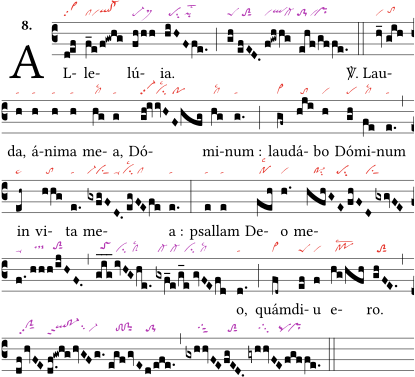
Gregorianischer Choral
"(c3)AL(d!ef|vi>pp2)le(f_e/f!gwhg[nv:\\definecolor{gregoriocolor}{RGB}{180,57,179}]|clviqlhh!cl-hh)l\u00fa(fh/hh|pe-ds>hg)ia. (hi/HF/fe.;|//pesu2/pilst2|gh//ef/ED.|peS/toS2sut1|//f!gwh/hg////ehf/gf/fe.[nv:\\definecolor{gregoriocolor}{RGB}{229,53,44}]|viqlhh``cl-/to-1/vi``pr) (::)\r\n\r\n<sp>V/</sp>. Lau(hv_//gih|vi//tohh)da,(h|ta) \u00e1(h|ta)ni(h|ta)ma(h|ta) me(hg|/cllsc2)a,(g|ta) D\u00f3(gh!ivivHF/hfg|vi-pp2cilsc2//po)mi(hg|/cllsc2)num :(g.|ta) (;) \r\nlau(gf~|cl~)d\u00e1(hji|//to)bo(h|vi) D\u00f3(gh|pe)mi(fe|/cllsc2)num(e.|ta) (,) \r\nin(eh~|pe~) vi(h/hg|//to)ta(e.|ta) me(gxfg/FD.//eg/FE/fe|vi-ciS//ta-/cilsc2/cl)a :(e.|ta) (:) \r\npsal(e|ta)lam(e|ta) De(feh|/polsc2)o(h.|vi) me(hfh/GE//fh/FD//gxgvFE[nv:\\definecolor{gregoriocolor}{RGB}{180,57,179}]|///po-1su2/////pesu2////////ciS|//f.|ta-|//hhh/ij/HF.|//ts-hh////toS2hhsut1)(,)(gig___/ivHG/he.//gxf_e/g_e//gvFE/fd[nv:\\definecolor{gregoriocolor}{RGB}{229,53,44}]|//toShh//ci//clSlsc2/////////cl-/cl-//ci//cllsc2)o,(d.|ta) (;) \r\nqu\u00e1m(fd~|cl~)di(ef|peS)u(f|vi) \r\ne(hg/hfh|//cl!polscw2)ro.(gh/FE.[nv:\\definecolor{gregoriocolor}{RGB}{180,57,179}]|//toS2sut1) (,) (df/hvFE|//ciGhhpp2|//d.f!gwhg/hvGF/g.|qlhh!po-1hhppt2su2/vi-|///egf/gvEd/efe.|///to!ciG//////to-1)(,)(gxh/hvFE|//////tgS3hh|/fg!ED.//gyh/hvFE/fgf/fe.[nv:\\definecolor{gregoriocolor}{RGB}{229,53,44}]|//toS2sut1//////////tg1hh////pq``pr) (::)\r\n\r\n\r\n\r\n\r\n\r\n\r\n"„Octavus perfectus (Der Achte ist vollkommen)“
Der 8. Ton (Hypomixolydisch) wird als weise, würdevoll und vollkommen beschrieben.
Mit diesem GABC Code kann der Choral z.B. mit GregorioTeX gerendert werden.