
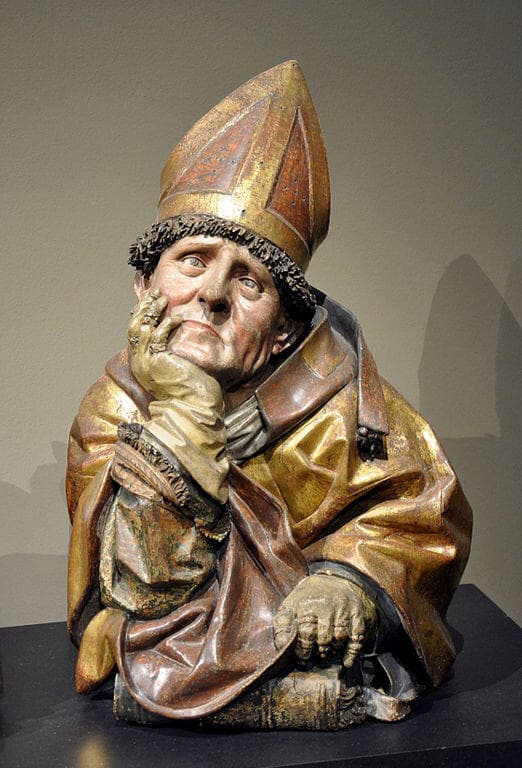
Augustine of Hippo
Catena Aurea · Matthäusevangelium 5
Ye have heard that it hath been said, Thou shalt love thy neighbour, and hate thine enemy. But I say unto you, Love your enemies, bless them that curse you, do good to them that hate you, and pray for them which despitefully use you and persecute you; That ye may be the children of your Father which is in heaven: for He maketh His sun to rise on the evil and on the good, and sendeth rain on the just and on the unjust. For if ye love them which love you, what reward have ye? do not even the Publicans the same? And if ye salute your brethren only, what do ye more than others? do not even the Publicans so? Be ye therefore perfect, even as your Father which is in heaven is perfect.
(Serm. in Mont. i. 21.) Here arises a question, that this commandment of the Lord, by which He bids us pray for our enemies, seems opposed by many other parts of Scripture. In the Prophets are found many imprecations upon enemies; such as that in the 108th Psalm, Let his children be orphans. (Ps. 109:9.) But it should be known, that the Prophets are wont to foretel things to come in the form of a prayer or wish. This has more weight as a difficulty that John says, There is a sin unto death, I sag not thathe shall pray for it; (1 John 5:16.) plainly shewing, that there are some brethren for whom he docs not bid us pray; for what went before was, If any know his brother sin a sin, &c. Yet the Lord bids us pray for our persecutors. This question can only be resolved, if we admit that there are some sins in brethren more grievous than the sin of persecution in our enemies. For thus Stephen prays for those that stoned him, because they had not yet believed on Christ; but the Apostle Paul (2 Tim. 4:14.) does not pray for Alexander though he was a brother, but had sinned by attacking the brotherhood through jealousy. But for whom you pray not, you do not therein pray against him. What must we say then of those against whom we know that the saints have prayed, and that not that they should be corrected, (for that would be rather to have prayed for them), but for their eternal damnation; not as that prayer of the Prophet against the Lord’s betrayer, for that is a prophecy of the future, not an imprecation of punishment; but as when we read in the Apocalypse the Martyrs’ prayer that they may be avenged. (Rev. 6:10.) But we ought not to let this affect us. For who may dare to affirm that they prayed against those persons themselves, and not against the kingdom of sin? For that would be both a just and a merciful avenging of the Martyrs, to overthrow that kingdom of sin, under the continuance of which they endured all those evils. And it is overthrown by correction of some, and damnation of such as abide in sin. Does not Paul seem to you to have avenged Stephen on his own body, as he speaks, (1 Cor. 9:27.) I chastise my body, and bring it into subjection.