
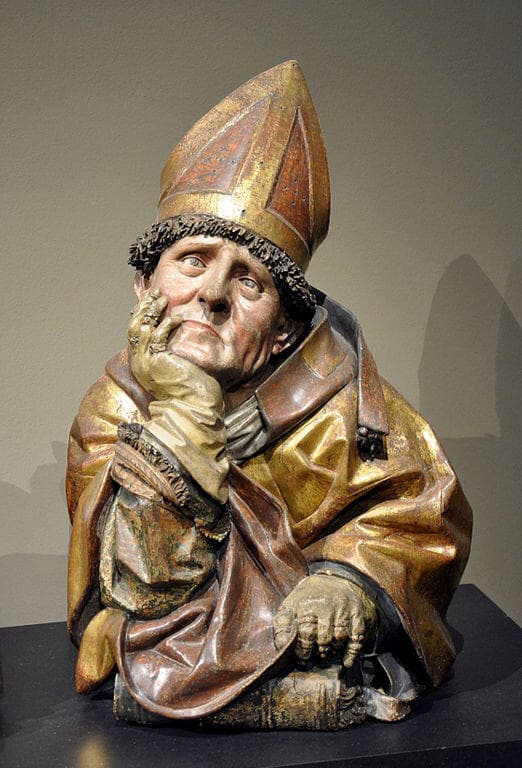
Augustine of Hippo
Catena Aurea · Matthäusevangelium 5
Again, ye have heard that it hath been said by them of old time, Thou shalt not forswear thyself, but shalt perform unto the Lord thine oaths: But I say unto you, Swear not at all; neither by Heaven; for it is God’s throne; Nor by the earth; for it is His footstool: neither by Jerusalem; for it is the city of the great King. Neither shalt thou swear by thy head, because thou canst not make one hair white or black. But let your communication be, Yea, yea; Nay, nay: for whatsoever is more than these cometh of evil.
(Serm. in Mont. i. 17.) This precept also confirms the righteousness of the Pharisees, not to forswear; inasmuch as he who swears not at all cannot forswear himself. But as to call God to witness is to swear, does not the Apostle break this commandment when he says several times to the Galatians, The things which I write unto you, behold, before God, I lie not. (Gal. 1:20.) So the Romans, God is my witness, whom I serve in my spirit. (Rom. 1:9) Unless perhaps some one may say, it is no oath unless I use the form of swearing by some object; and that the Apostle did not swear in saying, God is my witness. It is ridiculous to make such a distinction; yet the Apostle has used even this form, I die daily, by your boasting. (1 Cor. 15:31.) That this does not mean, your boasting has caused my dying daily, but is an oath, is clear from the Greek, which is νὴ τὴν ὑμετέραν καύχησιν.