
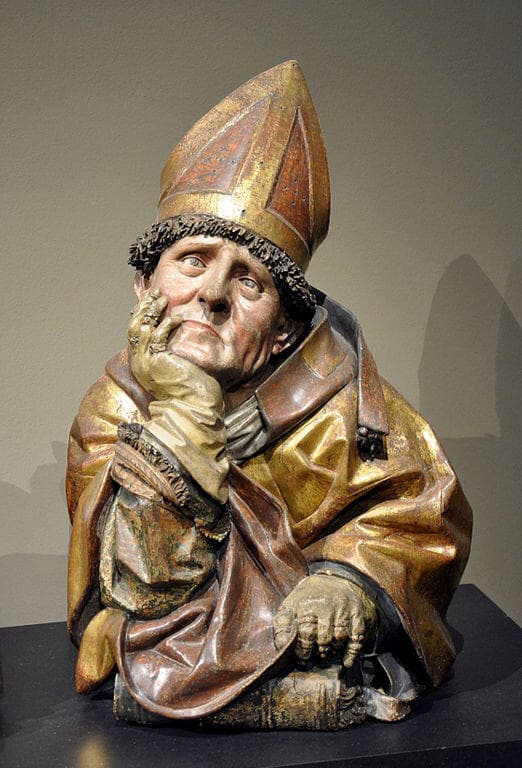
Augustine of Hippo
Catena Aurea · Matthäusevangelium 5
It hath been said, Whosoever shall put away his wife, let him give her a writing of divorcement: But I say unto you, That whosoever shall put away his wife, saving for the cause of fornication, causeth her to commit adultery: and whosoever shall marry her that is divorced committeth adultery.
(cont. Fasust. xix. 26.) The Lord’s command here that a wife is not to be put away, is not contrary to the command in the Law, as Manichæus affirmed. Had the Law allowed any who would to put away his wife, to allow none to put away were indeed the very opposite of that. But the difficulty which Moses is careful to put in the way, shews that he was no good friend to the practice at all. For he required a bill of divorcement, the delay and difficulty of drawing out which would often cool headlong rage and disagreement, especially as by the Hebrew custom, it was the Scribes alone who were permitted to use the Hebrew letters, in which they professed a singular skill. To these then the law would send him whom it bid to give a writing of divorcement, when he would put away his wife, who mediating between him and his wife, might set them at one again, unless in minds too wayward to be moved by counsels of peace. Thus then He neither completed, by adding words to it, the law of them of old time, nor did He destroy the Law given by Moses by enacting things contrary to it, as Manichæus affirmed; but rather repeated and approved all that the Hebrew Law contained, so that whatever He spoke in His own person more than it had, had in view either explanation, which in divers obscure places of the Law was greatly needed, or the more punctual observance of its enactments.