
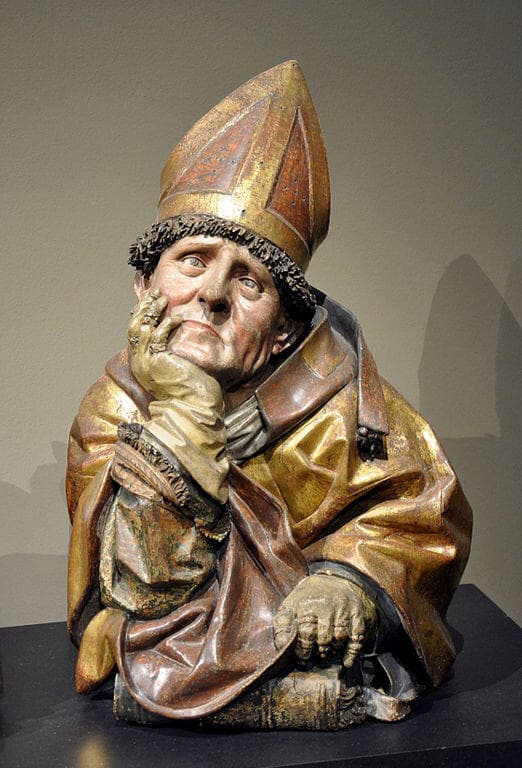
Augustine of Hippo
Catena Aurea · Matthäusevangelium 28
In the end of the sabbath, as it began to dawn toward the first day of the week, came Mary Magdalene and the other Mary to see the sepulchre. And, behold, there was a great earthquake: for the angel of the Lord descended from heaven, and came and rolled back the stone from the door, and sat upon it. His countenance was like lightning, and his raiment white as snow: And for fear of him the keepers did shake, and became as dead men. And the angel answered and said unto the women, Fear not ye: for I know that ye seek Jesus, which was crucified. He is not here: for he is risen, as he said. Come, see the place where the Lord lay. And go quickly and tell his disciples that he is risen from the dead; and, behold, he goeth before you into Galilee; there shall ye see him: lo, I have told you.
(de Cons. Ev. iii. 24.) Concerning the hour when the women came to the sepulchre there arises a question not to be overlooked. Matthew here says, On the evening of the Sabbath. What then means that of Mark, Very early in the morning, the first day of the week? (Mark 16:2.) Truly Matthew, by naming the first part of the night, to wit, the evening, denotes the whole night in the end of which they come to the sepulchre. But seeing the Sabbath hindered them from doing this before, he designates the whole night by the earliest portion of it in which it became lawful for them to do whatever, during some period of the night, they designed to do. Thus, On the evening of the sabbath, is just the same as if he had said, On the night of the sabbath, i. e. the night which follows the day of the sabbath, which is sufficiently proved by the words which follow, As it began to dawn towards the first day of the week. This could not be if we understood only the first portion of the night, its beginning, to be conveyed by the word, evening. For the evening or beginning of the night does not begin to dawn towards the first day of the week, but only the night which is concluded by the dawn. And this is the usual mode of speaking in Holy Scripture, to express the whole by a part. By evening therefore he implied the night, in the end of which they came to the sepulchre.