
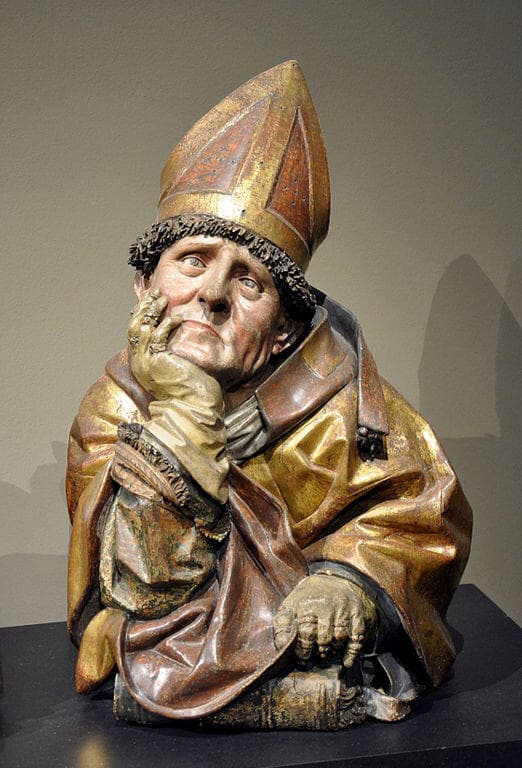
Augustine of Hippo
Catena Aurea · Matthäusevangelium 27
Now from the sixth hour there was darkness over all the land unto the ninth hour. And about the ninth hour Jesus cried with a loud voice, saying, Eli, Eli, lama sabachthani? that is to say, My God, may God, why hast thou forsaken me? Some of them that stood there, when they heard that, said, This man calleth for Elias. And straightway one of them ran, and took a spunge, and filled it with vinegar, and put it on a reed, and gave him to drink. The rest said, Let be, let us see whether Elias will come to save him. Jesus, when he had cried again with a loud voice, yielded up the ghost. PSEUDO-DIONYSIUS. (ad Polycarp. Ep. 7.) When we were together at Heliopolis, we both observed such an interference of the moon with the sun quite unexpectedly, for it was not the season of their conjunction; and then from the ninth hour until evening, beyond the power of nature, continuing in a direct line between us and the sun. And this obscuration we saw begin from the east, and so pass to the extreme of the sun’s orb, and again return back the same way, being thus the very reverse of an ordinary eclipse.
(in Serm. non occ.) When now nought of suffering remains to be endured, death still lingers, knowing that it has nothing there. The ancient foe suspected somewhat unusual. This man, first and only, he found having no sin, free from guilt, owing nothing to the laws of his jurisdiction. But leagued with Jewish madness, Death comes again to the assault, and desperately invades the Life-giver. And Jesus, when he had cried again with a loud voice, yielded up the ghost. Wherefore should we be offended that Christcame from the bosom of the Father to take upon Him our bondage, that He might confer on us His freedom; to take upon Him our death, that we might be set free by His death; by despising death He exalted us mortals into Gods, counted them of earth worthy of things in heaven? For seeing the Divine power shines forth so brilliant in the contemplation of its works, it is an argument of boundless love, that it suffers for its subjects, dies for its bondsmen. This then was the first cause of the Lord’s Passion, that He would have it known how great God’s love to man, Who desired rather to be loved than feared. The second was that He might abolish with yet more justice the sentence of death which He had with justice passed. For as the first man had by guilt incurred death through God’s sentence, and handed down the same to his posterity, the second Man, who knew no sin, came from heaven that death might be condemned, which, when commissioned to seize the guilty, had presumed to touch the Author of sinlessness. And it is no wonder if for us He laid down what He had taken of us, His life, namely, when He has done other so great things for us, and bestowed so much on us.