
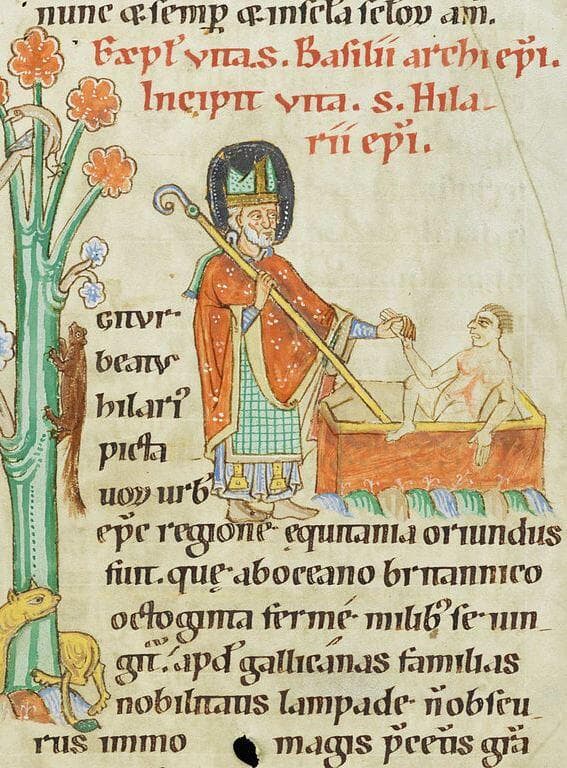
Hilary of Poitiers
Catena Aurea · Matthäusevangelium 27
Now from the sixth hour there was darkness over all the land unto the ninth hour. And about the ninth hour Jesus cried with a loud voice, saying, Eli, Eli, lama sabachthani? that is to say, My God, may God, why hast thou forsaken me? Some of them that stood there, when they heard that, said, This man calleth for Elias. And straightway one of them ran, and took a spunge, and filled it with vinegar, and put it on a reed, and gave him to drink. The rest said, Let be, let us see whether Elias will come to save him. Jesus, when he had cried again with a loud voice, yielded up the ghost. PSEUDO-DIONYSIUS. (ad Polycarp. Ep. 7.) When we were together at Heliopolis, we both observed such an interference of the moon with the sun quite unexpectedly, for it was not the season of their conjunction; and then from the ninth hour until evening, beyond the power of nature, continuing in a direct line between us and the sun. And this obscuration we saw begin from the east, and so pass to the extreme of the sun’s orb, and again return back the same way, being thus the very reverse of an ordinary eclipse.
(de Trin. x. 50 &c.) From these words heretical spirits contend either that God the Word was entirely absorbed into the soul at the time it discharged the function of a soul in quickening the body; or that Christ could not have been born man, because the Divine Word dwelt in Him after the manner of a prophetical spirit. As though Jesus Christ was a man of ordinary soul and body, having His beginning then when He began to be man, and thus now deserted upon the withdrawal of the protection of God’s word cries out, My God, my God, why hast thou forsaken me? Or at least that the nature of the Word being transmuted into soul, Christ, who had depended in all things upon His Father’s support, now deserted and left to death, mourns over this desertion, and pleads with Him departing. But amidst these impious and feeble opinions, the faith of the Church imbued with Apostolic teaching does not sever Christ that He should be considered as Son of God and not as Son of Man. The complaint of His being deserted is the weakness of the dying man; the promise of Paradise is the kingdom of the living God. You have Him complaining that He is left to death, and thus He is Man; you have Him as He is dying declaring that He reigns in Paradise; and thus He is God. Wonder not then at the humility of these words, when you know the form of a servant, and see the offence of the cross.