
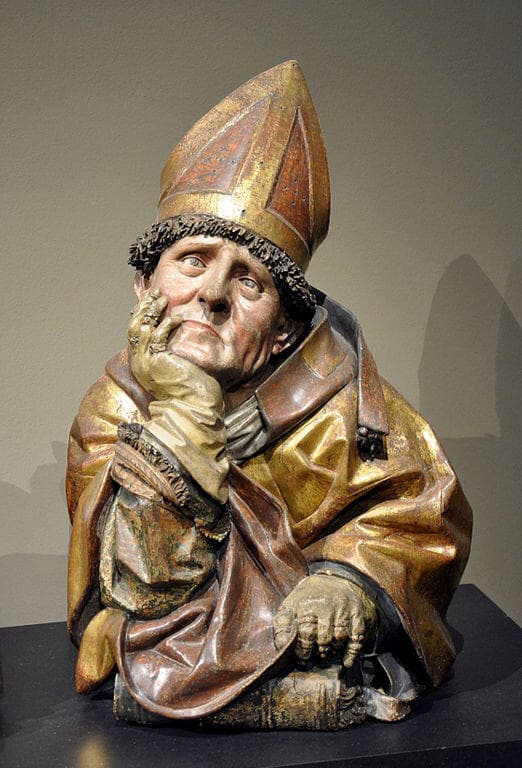
Augustine of Hippo
Catena Aurea · Matthäusevangelium 27
And the Chief Priests took the silver pieces, and said, It is not lawful for to put them into the treasury, because it is the price of blood. And they took counsel, and bought with them the potter’s field, to bury strangers in. Wherefore that field was called, The field of blood, unto this day. Then was fulfilled that which was spoken by Jeremy the prophet, saying, And they took the thirty pieces of silver, the price of him that was valued, whom they of the children of Israel did value; And gave them for the potter’s field, as the Lord appointed me.
(de Cons. Ev. iii. 7.) But if any one thinks this lowers the historian’s credit, first let him know that not all the copies of the Gospels have the name Hieremias, but some simply by the Prophet. But I do not like this defence, because the more, and the more ancient, copies have Hieremias, and there could be no reason for adding the name, and thus making an error. But its erasure is well accounted for by the hardihood of ignorance having heard the foregoing objection urged. It might be then, that the name Hieremias occurred to the mind of Matthew as he wrote, instead of the name Zacharias, as so often happens; and that he would have straightway corrected it, when pointed out to him by such as read this while he yet lived in the flesh, had he not thought that his memory, being guided by the Holy Spirit, would not thus have called up to him one name instead of another, had not the Lord determined that it should thus be written. And why He should have so determined, the first reason is, that it would convey the wonderful consent of the Prophets, who all spake by one Spirit, which is much greater than if all the words of all the Prophets had been uttered through the mouth of one man; so that we receive without doubt whatever the Holy Spirit spake through them, each word belongs to all in common, and the whole is the utterance of each. Suppose it to happen at this day, that in repeating another’s words one should mention not the speaker’s name, but that of some other person, who however was the other’s greater friend, and then immediately recollecting himself should correct himself, he might yet add, Yet am I right, if you only think of the close unanimity that exists between the two. How much more is this to be observed of the holy Prophets! There is a second reason why the name Hieremias should be suffered to remain in this quotation from Zacharias, or rather why it should have been suggested by the Holy Spirit. (Jer. 32:9.) It is said in Hieremias, that he bought a field of his brother’s son, and gave him silver for it, though not indeed the sum stated in Zacharias, thirty pieces of silver. That the Evangelist has here adapted the thirty pieces of silver in Zacharias to this transaction in the Lord’s history, is plain; but he may also wish to convey that what Hieremias speaks of the field is mystically alluded to here, and therefore he puts not the name of Zacharias who spoke of the thirty pieces of silver, but of Hieremias who spoke of the purchase of the field. So that in reading the Gospel and finding the name of Hieremias, but not finding there the passage respecting the thirty pieces of silver, but the account of the purchase of the field, the reader might be induced to compare the two together, and so extract from them the sense of the prophecy, how far it refers to what was now accomplished in the Lord. For what Matthew adds to the prophecy, Whom they of the children of Israel did value, and gave them for the potter’s field, as the Lord appointed me, this, as the Lord appointed me, is found neither in Zacharias nor Hieremias. It must then be taken in the person of the Evangelist as inserted with a mystic meaning, that he had learned by revelation that the prophecy referred to this matter of the price for which Christ was betrayed.