
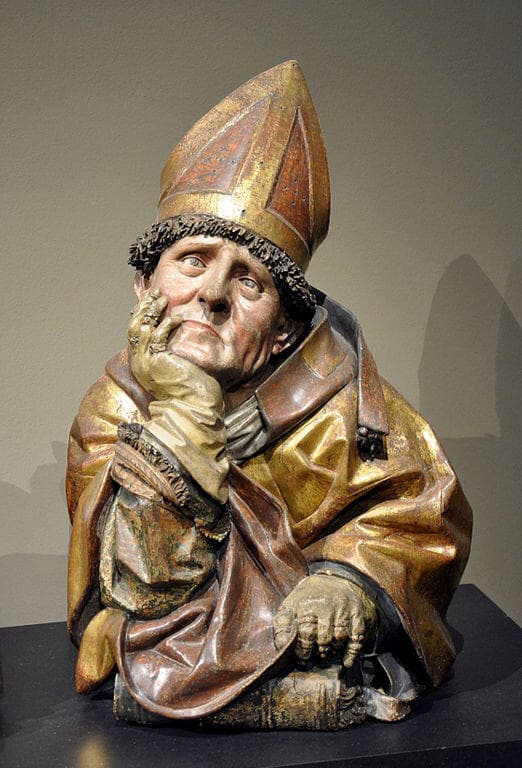
Augustine of Hippo
Catena Aurea · Matthäusevangelium 26
Now when Jesus was in Bethany, in the house of Simon the leper, There came unto him a woman having an alabaster box of very precious ointment, and poured it on his head, as he sat at meat. But when his disciples saw it, they had indignation, saying, To what purpose is this waste? For this ointment might have been sold for much, and given to the poor. When Jesus understood it, he said unto them, Why trouble ye the woman? for she hath wrought a good work upon me. For ye have the poor always with you; but me ye have not always. For in that she hath poured this ointment on my body, she did it for my burial. Verily I say unto you, Wheresoever this Gospel shall be preached in the whole world, there shall also this, that this woman hath done, be told for a memorial of her.
(de Cons. Ev. ii, 79.) Though the action described in Luke is the same as that described here, and the name of him with whom the Lord supped is the same, for Luke also names Simon; yet because it is not contrary to either nature or custom for two men to bear the same name, it is more probable that this was another Simon, not the leper, in whose house in Bethany these things were done. I would onlysuppose that the woman who on that occasion came near to Jesus’ feet, and this woman, were not two different persons, but that the same Mary did this twice. The first time is that narrated by Luke; for John mentions it in praise of Mary before Christ’s coming to Bethany, It was that Mary who anointed the Lord with ointment, and wiped his feet with her hair, whose brother Lazarus was sick. (John 11:2.) Mary therefore had done this before. That she did afterwards in Bethany is distinct from Luke’s account, but is the same event that is recorded by all three, John, Matthew, and Mark. That Matthew and Mark say it was the Lord’s head that she anointed, and John His feet, is reconciled by supposing that she anointed both. Against this one might raise a cavil from what Mark says, that she anointed His head by breaking the box over it, so that there could be none of the ointment left with which to anoint His feet also. Let such caviller understand, that His feet were first anointed before the box was broken, and there remained in it, yet whole, enough wherewith to anoint the head by breaking the box and shedding the contents.