
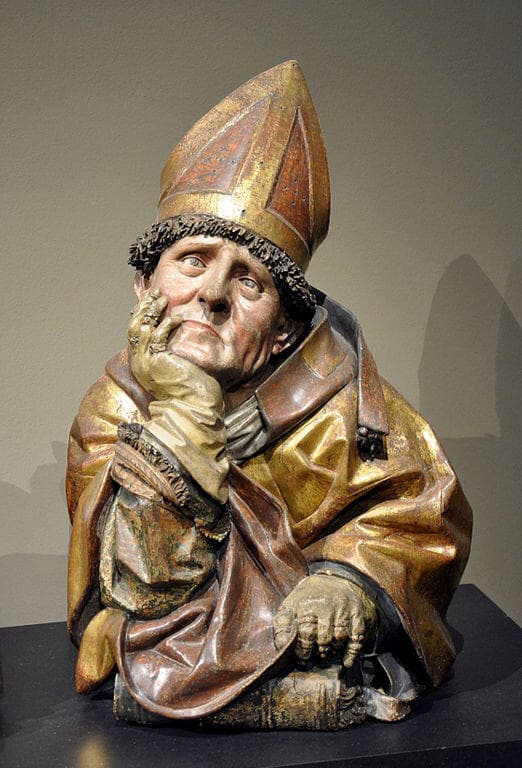
Augustine of Hippo
Catena Aurea · Matthäusevangelium 25
When the Son of man shall come in his glory, and all the holy angels with him, then shall he sit upon the throne of his glory: And before him shall be gathered all nations: and he shall separate them one from another, as a shepherd divideth his sheep from the goats: And he shall set the sheep on his right hand, but the goats on the left. Then shall the King say unto them on his right hand, Come, ye blessed of my Father, inherit the kingdom prepared for you from the foundation of the world: For I was an hungred, and ye gave me meat: I was thirsty, and ye gave me drink: I was a stranger, and ye took me in: Naked, and ye clothed me: I was sick, and ye visited me: I was in prison, and ye came unto me. Then shall the righteous answer him, saying, Lord, when saw we thee an hungred, and fed thee? or thirsty, and gave thee drink? When saw we thee a stranger, and took thee in? or naked, and clothed thee? Or when saw we thee sick, or in prison, and came unto thee And the King shall answer and say unto them, Verily I say unto you, Inasmuch as ye have done it unto one of the least of these my brethren, ye have done it unto me. Then shall he say also unto them on the left hand, Depart from me, ye cursed, into everlasting fire, prepared for the devil and his angels: For I was an hungred, and ye gave me no meat: I was thirsty, and ye gave me no drink: I was a stranger, and ye took me not in: naked, and ye clothed me not: sick, and in prison, and ye visited me not. Then shall they also answer him, saying, Lord, when saw we thee an hungred, or athirst, or a stranger, or naked, or sick, or in prison, and did not minister unto thee? Then shall he answer them, saying, Verily I say unto you, Inasmuch as ye did it not to one of the least of these, ye did it not to me.
(de Civ. Dei, xxi. 10.) It is hence clear, that the same fire will be appropriated to the punishment of men and of dæmons. If then it inflicts pain by corporeal touch, so as to produce bodily torment, how will there be in it any punishment for the evil spirits, unless the dæmons have, as some have thought, bodies composed of gross and fluid air. But if any man asserts that the dæmons have no bodies, we would not pugnaciously contend the point. For why may we not say, that truly, though wonderfully, even incorporeal spirit can feel pain of corporeal fire? If the spirits of men, though themselves incorporeal, can be now inclosed in bodily limbs, they can then be inseparably attached to the bonds of body. The dæmons then will be united to a body of material fire, though themselves immaterial, drawing punishment from their body, not giving life to it. And that fire being material will torture such bodies as ours with their spirits; but the dæmons are spirits without bodies.