
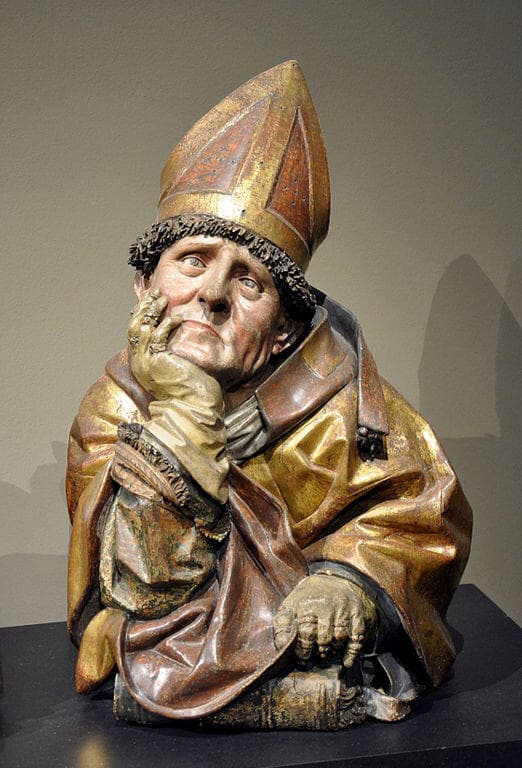
Augustine of Hippo
Catena Aurea · Matthäusevangelium 21
And when they drew nigh unto Jerusalem, and were come to Bethphage, unto the mount of Olives, then sent Jesus two disciples, Saying unto them, Go into the village over against you, and straightway ye shall find an ass tied, and a colt with her: loose them, and bring them unto me. And if any man say ought unto you, ye shall say, The Lord hath need of them; and straightway he will send them. And this was done, that it might be fulfilled which was spoken by the prophet, saying, Tell ye the daughter of Sion, Behold, thy King cometh unto thee, meek, and sitting upon an ass, and a colt the foal of an ass. And the disciples went, and did as Jesus commanded them, And brought the ass, and the colt, and put on them their clothes, and they set him thereon. And a very great multitude spread their garments in the way; others cut down branches from the trees, and strawed them in the way. And the multitudes that went before, and that followed, cried, saying, Hosanna to the Son of David: Blessed is he that cometh in the name of the Lord; Hosanna in the highest.
(de Cons. Ev. ii. 66.) In this quotation from the Prophet, there is some variety in the different Gospels. Matthew quotes it as if the Prophet had expressly mentioned the she-ass; but it is not so quoted by John, nor in the Church-copies of the translation in common use. (John 12:15) This seems to me to be accounted for by the account, that Matthew wrote his Gospel in the Hebrew language. And it is clear that the translation called the LXX, has some things different from what are found in the Hebrew, by those who know that tongue, and who have rendered the same books out of the Hebrew. If the reason of this discrepancy be asked, I consider nothing more likely than that the LXX interpreted with the selfsame spirit with which the original was written, which is confirmed by that wonderful agreement among them of which we are told. By thus varying the expression, while they did not depart from the meaning of that God whose words they were, they convey to us the very same thing as we gather from this agreement, with slight variety, among the Evangelists. This shews us that it is no lie, when one relates any thing with such diversities in detail, as that he does not depart from his intention with whom he ought to agree. To know this is useful in morals in avoiding lies; and for faith itself, that we should not suppose that the truth is secured in sacred sounds, as though God imparted to us not the matter only, but the words in which thematter is conveyed. Rather the matter is in such sort conveyed in words, that we ought not to want words at all, if it were possible that the matter could be known by us without words, as God and His Angels know it. It follows, But the disciples went and did as Jesus commanded them, and brought the ass, and the colt. The other Evangelists say nothing of the ass. And if Matthew had not mentioned the colt, as they do not mention the ass, the reader ought not to have been surprised. How much less then should it move him, when one has so mentioned the ass which the others have omitted, as not to forget the colt which they have mentioned. For there is no discrepancy where both circumstances may have occurred, though one only related one, and another another; how much less then where one mentions both, though another mentions only one? It follows, And they put on them their clothes, and set him thereon.