
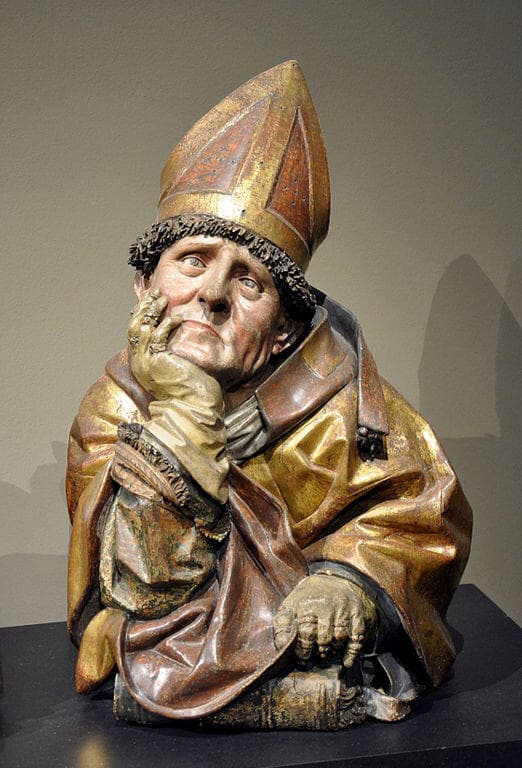
Augustine of Hippo
Catena Aurea · Markusevangelium 9
And John answered him, saying, Master, we saw one casting out devils in thy name, and he followeth not us: and we forbad him, because he followeth not us. But Jesus said, Forbid him not: for there is no man which shall do a miracle in my name, that can lightly speak evil of me. For he that is not against us is on our part. For whosoever shall give you a cup of water to drink in my name, because ye belong to Christ, verily I say unto you, he shall not lose his reward. And whosoever shall offend one of these little ones that believe in me, it is better for him that a millstone were hanged about his neck, and he were cast into the sea.
(de Con. Evan. 4. 5.) We must take care that this saying of the Lord appear not to be contrary to that, where He says, He who is not with me is against me. (Luke 11:23) Or will any one say that the difference lies in that here He says to His disciples, For he that is not against you is on your part, but in the other He speaks of Himself, He who is not with me is against me? As if indeed it were possiblel that he who is joined to Christ’s disciples, who are as His members, should not be with Him. How if it were so, could it be true that he that receiveth you receiveth me? (Matt. 10:40) Or how is he not against Him, who is against His disciples? Where then will be that saying, He who despiseth you, despiseth me? But surely what is implied is, that a man is not with Him in as far as he is against Him, and is not against Him in as far as he is with Him. For instance, he who worked miracles in the name of Christ, and yet did not join himself to the body of His disciples, in as far as he worked the miracles in His name, was with them, and was not against them: again, in that he did not join their society, he was not with them, and was against them. But because they forbade his doing that in which he was with them, the Lord said unto them, Forbid him not; for they ought to have forbidden his being without their society, and thus to have persuaded him of the unity of the Church, but they should not have forbidden that in which he was with them, that is, his commendation of the name of their Lord and Master by the expulsion of devils. Thus the Church Catholic does not disapprove in heretics the sacraments, which are common, but she blames their division, or some opinion of theirs adverse to peace and to truth; for in this they are against us.