
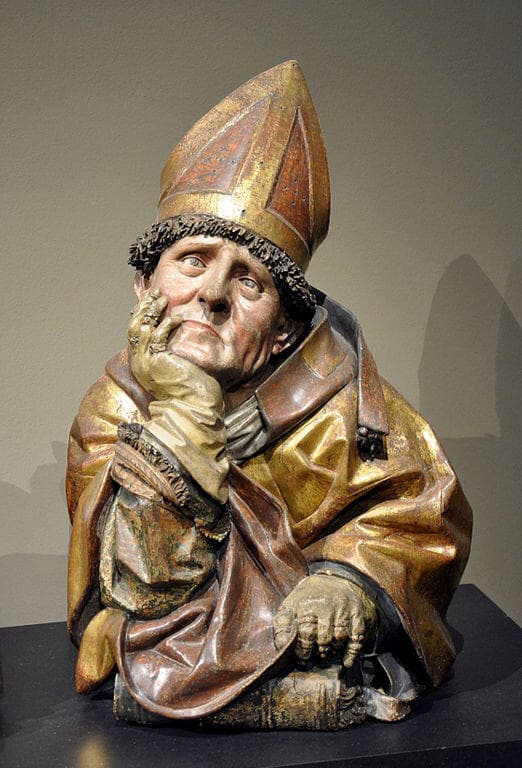
Augustine of Hippo
Catena Aurea · Markusevangelium 6
And when the day was now far spent, his disciples came unto him, and said, This is a desert place, and now the time is far passed: Send them away, that they may go into the country round about, and into the villages, and buy themselves bread: for they have nothing to eat. He answered and said unto them, Give ye them to eat. And they say unto him, Shall we go and buy two hundred pennyworth of bread, and give them to eat? He saith unto them, How many loaves have ye? go and see. And when they knew, they say, Five, and two fishes. And he commanded them to make all sit down by companies upon the green grass. And they sat down in ranks, by hundreds, and by fifties. And when he had taken the five loaves and the two fishes, he looked up to heaven, and blessed, and brake the loaves, and gave them to his disciples to set before them; and the two fishes divided he among them all. And they did all eat, and were filled. And they took up twelve baskets full of the fragments, and of the fishes. And they that did eat of the loaves were about five thousand men.
(Con. Evan. 2. 46) This in the Gospel of John is the answer of Philip, but Mark gives it as the answer of the disciples, wishing it to be understood that Philip made this answer as a mouthpiece of the others; although he might put the plural number for the singular, as is usual. It goes on, And he saith unto them, How many loaves hare ye? go and see. The other Evangelists pass over this being done by the Lord. It goes on, And when they knew, they say, Five, and two fishes. This, which was suggested by Andrew, as we learn from John, the other Evangelists, using the plural for the singular, have put into the mouth of the disciples. It goes on, And he commanded them to wake all sit down by companies upon the green grass, and they sat down in ranks by hundreds and by fifties. But we need not be perplexed, though Luke says that they were ordered to sit down by fifties, and Mark by hundreds and fifties, for one has mentioned a part, the other the whole. Mark, who mentions the hundreds, fills up what the other has left out.