
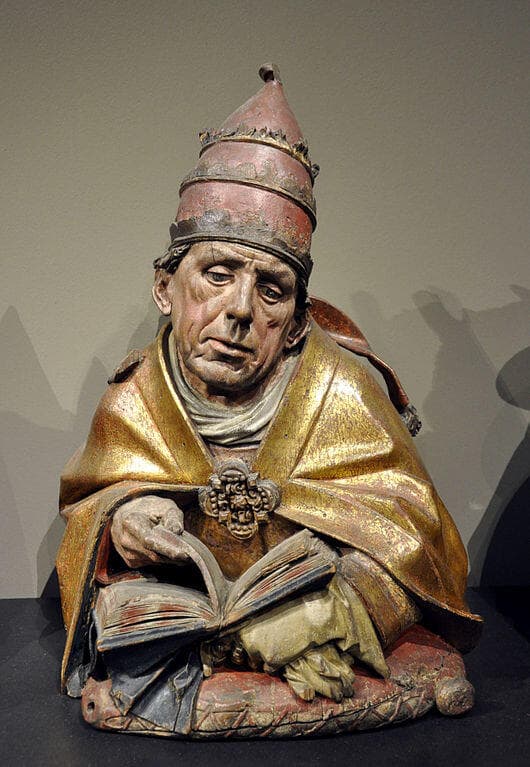
Gregory the Great
Catena Aurea · Lukasevangelium 7
And one of the Pharisees desired him that he would eat with him. And he went into the Pharisee’s house, and sat down to meat. And, behold, a woman in the city, which was a sinner, when she knew that Jesus sat at meat in the Pharisee’s house, brought an alabaster box of ointment, And stood at his feet behind him weeping, and began to wash his feet with tears, and did wipe them with the hairs of her head, and kissed his feet, and anointed them with the ointment. Now when the Pharisee which had bidden him saw it, he spake within himself, saying, This man, if he were a prophet, would have known who and what manner of woman this is that toucheth him: for she is a sinner. And Jesus answering said unto him, Simon, I have somewhat to say unto thee. And he saith, Master, say on. There was a certain creditor which had two debtors: the one owed five hundred pence, and the other fifty. And when they had nothing to pay, he frankly forgave them both. Tell me therefore, which of them will love him most? Simon answered and said, I suppose that he, to whom he forgave most. And he said unto him, Thou hast rightly judged. And he turned to the woman, and said unto Simon, Seest thou this woman? I entered into thine house, thou gavest me no water for my feet: but she hath washed my feet with tears, and wiped them with the hairs of her head. Thou gavest me no kiss: but this woman since the time I came in hath not ceased to kiss my feet. My head with oil thou didst not anoint: but this woman hath anointed my feet with ointment. Wherefore I say unto thee, Her sins, which are many, are forgiven; for she loved much: but to whom little is forgiven, the same loveth little. And he said unto her, Thy sins are forgiven. And they that sat at meat with him began to say within themselves, Who is this that forgiveth sins also? And he said to the woman, Thy faith hath saved thee: go in peace.
(ubi sup.) The woman kisses the feet which she has wiped. This also we fully do when we ardently love those whom we maintain by our bounty. By the feet also may be understood the mystery itself of the Incarnation. We then kiss the feet of the Redeemer when we love with our whole heart the mystery of the Incarnation. We anoint the feet with ointment, when we proclaim the power of His humanity with the good tidings of holy eloquence. But this also the Pharisee sees and grudges, for when the Jewish people perceives that the Gentiles preach God, it consumes away by its own malice. But the Pharisee is thus repulsed, that as it were through Him that false people might be made manifest, for in truth that unbelieving people never offered to the Lord even those things which were without them; but the Gentiles being converted, poured forth not only their substance but their blood. Hence He says to the Pharisee, Thou gavest me no water for my feet, but she hath washed my feet with her tears; for water is without us, the moisture of tears is within us. That unfaithful people also gave no kiss to the Lord, for it was unwilling to embrace Him from love whom it obeyed from fear, (for the kiss is the sign of love,) but the Gentiles being called cease not to kiss the feet of their Redeemer, for they ever breathe in His love.