
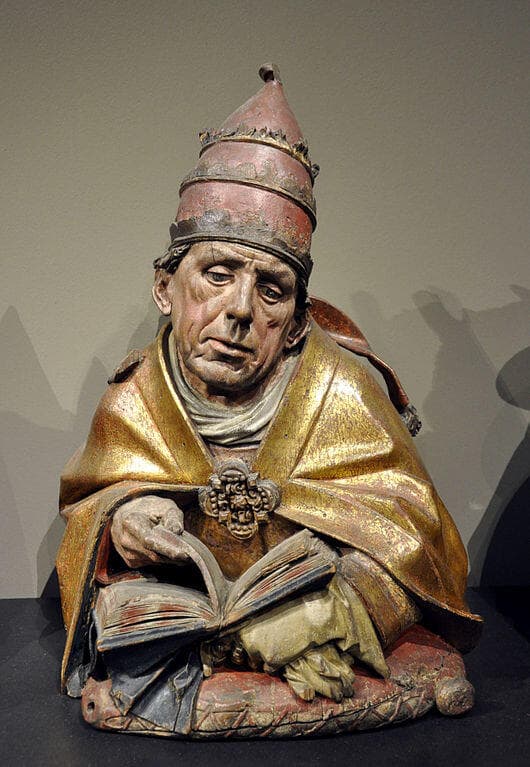
Gregory the Great
Catena Aurea · Lukasevangelium 7
And one of the Pharisees desired him that he would eat with him. And he went into the Pharisee’s house, and sat down to meat. And, behold, a woman in the city, which was a sinner, when she knew that Jesus sat at meat in the Pharisee’s house, brought an alabaster box of ointment, And stood at his feet behind him weeping, and began to wash his feet with tears, and did wipe them with the hairs of her head, and kissed his feet, and anointed them with the ointment. Now when the Pharisee which had bidden him saw it, he spake within himself, saying, This man, if he were a prophet, would have known who and what manner of woman this is that toucheth him: for she is a sinner. And Jesus answering said unto him, Simon, I have somewhat to say unto thee. And he saith, Master, say on. There was a certain creditor which had two debtors: the one owed five hundred pence, and the other fifty. And when they had nothing to pay, he frankly forgave them both. Tell me therefore, which of them will love him most? Simon answered and said, I suppose that he, to whom he forgave most. And he said unto him, Thou hast rightly judged. And he turned to the woman, and said unto Simon, Seest thou this woman? I entered into thine house, thou gavest me no water for my feet: but she hath washed my feet with tears, and wiped them with the hairs of her head. Thou gavest me no kiss: but this woman since the time I came in hath not ceased to kiss my feet. My head with oil thou didst not anoint: but this woman hath anointed my feet with ointment. Wherefore I say unto thee, Her sins, which are many, are forgiven; for she loved much: but to whom little is forgiven, the same loveth little. And he said unto her, Thy sins are forgiven. And they that sat at meat with him began to say within themselves, Who is this that forgiveth sins also? And he said to the woman, Thy faith hath saved thee: go in peace.
(ubi sup.) But the Pharisee beholding these things despises them, and finds fault, not only with the woman who was a sinner, but with the Lord who received her, as it follows, Now when the Pharisee who had bidden him saw it, he spake within himself, saying, This man, if he were a prophet, would have known who and what manner of woman this is which toucheth him. We see the Pharisee really proud in himself, and hypocritically righteous, blaming the sick woman for her sickness, the physician for his aid. The woman surely if she had come to the feet of the Pharisee would have departed with the heel lifted up against her. For he would have thought that he was polluted by another’s sin, not having sufficient of his own real righteousness to fill him. So also some gifted with the priests’ office, if perchance they have done any just thing outwardly or slightly, forthwith despise those who are put under them, and look with disdain on sinners who are of the people. But when we behold sinners, we must first bewail ourselves for their calamity, since we perhaps have had and are certainly liable to a similar fall. But it is necessary that we should carefully distinguish, for we are bound to make distinction in vices, but to have compassion on nature. For if we must punish the sinner, we must cherish a brother. But when by penance he has himself punished his own deed, our brother is no more a sinner, for he punished in himself what Divine justice condemned. The Physician was between two sick persons, but the one preserved her faculties in the fever, the other lost his mental perception. For she wept at what she had done; but the Pharisee, elated with a false sense of righteousness, overrated the vigour of his own health.