
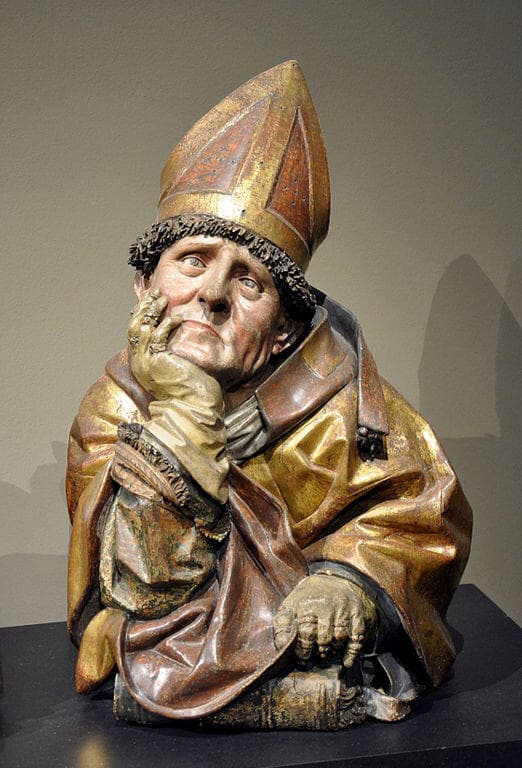
Augustine of Hippo
Catena Aurea · Lukasevangelium 20
Then came to him certain of the Sadducees, which deny that there is any resurrection; and they asked him, Saying, Master, Moses wrote unto us, If any man’s brother die, having a wife, and he die without children, that his brother should take his wife, and raise up seed unto his brother. There were therefore seven brethren: and the first took a wife, and died without children. And the second took her to wife, and he died childless. And the third took her; and in like manner the seven also: and they left no children, and died. Last of all the woman died also. Therefore in the resurrection whose wife of them is she? for seven had her to wife. And Jesus answering said unto them, The children of this world marry, and are given in marriage: But they which shall be accounted worthy to obtain that world, and the resurrection from the dead, neither marry, nor are given in marriage: Neither can they die any more: for they are equal unto the angels; and are the children of God, being the children of the resurrection. Now that the dead are raised, even Moses shewed at the bush, when he calleth the Lord the God of Abraham, and the God of Isaac, and the God of Jacob. For he is not a God of the dead, but of the living: for all live unto him. Then certain of the Scribes answering said, Master, thou hast well said. And after that they durst not ask him any question at all.
(de Quæst. Ev. ubi sup.) As our discourse is made up and completed by departing and succeeding syllables, so also men themselves whose faculty discourse is, by departure and succession make up and complete the order of this world, which is built up with the mere temporal beauty of things. But in the future life, seeing that the Word which we shall enjoy is formed by no departure and succession of syllables, but all things which it has it has everlastingly and at once, so those who partake of it, to whom it alone will be life, shall neither depart by death, nor succeed by birth, even as it now is with the angels; as it follows, For they are equal to the angels.