
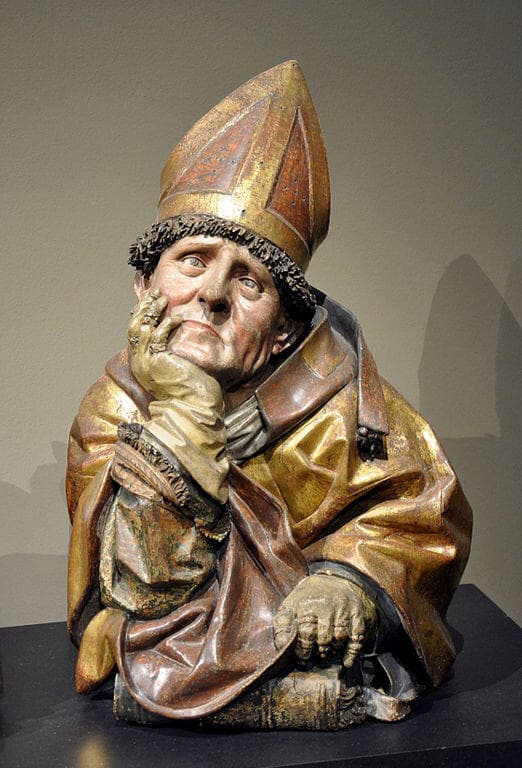
Augustine of Hippo
Catena Aurea · Lukasevangelium 16
And it came to pass, that the beggar died, and was carried by the angels into Abraham’s bosom: the rich man also died, and was buried; And in hell he lift up his eyes, being in torments, and seeth Abraham afar off, and Lazarus in his bosom. And he cried and said, Father Abraham, have mercy on me, and send Lazarus, that he may dip the tip of his finger in water, and cool my tongue; for I am tormented in this flame. But Abraham said, Son, remember that thou in thy lifetime receivedst thy good things, and likewise Lazarus evil things: but now he is comforted, and thou art tormented. And beside all this, between us and you there is a great gulf fixed: so that they which would pass from hence to you cannot; neither can they pass to us, that would come from thence. PSEUDO-BASIL. (In Esai. 5.) Hell is a certain common place in the interior of the earth, shaded on all sides and dark, in which there is a kind of opening stretching downward, through which lies the descent of the souls who are condemned to perdition.
(Qu. Ev. lib. ii. qu. 88.) For it is shewn by the unchangeableness of the Divine sentence, that no aid of mercy can be rendered to men by the righteous, even though they should wish to give it; by which he reminds us, that in this life men should relieve those they can, since hereafter even if they be well received, they would not be able to give help to those they love. For that which was written, that they may receive you into everlasting habitations, was not said of the proud and unmerciful, but of those who have made to themselves friends by their works of mercy, whom the righteous receive, not as if by their own power benefitting them, but by Divine permission.