
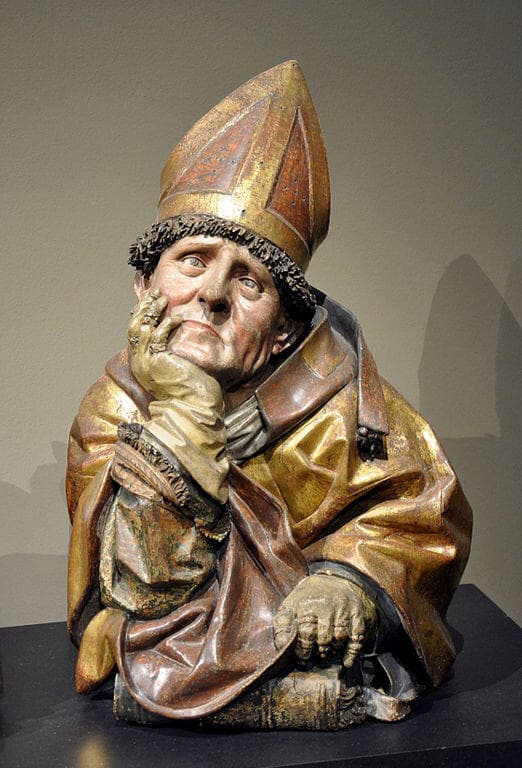
Augustine of Hippo
Catena Aurea · Lukasevangelium 15
Now his elder son was in the field: and as he came and drew nigh to the house, he heard musick and dancing. And he called one of the servants, and asked what these things meant. And he said unto him, Thy brother is come; and thy father hath killed the fatted calf, because he hath received him safe and sound. And he was angry, and would not go in: therefore came his father out, and intreated him. And he answering said to his father, Lo, these many years do I serve thee, neither transgressed I at any time thy commandment: and yet thou never gavest me a kid, that I might make merry with my friends: But as soon as this thy son was come, which hath devoured thy living with harlots, thou hast killed for him the fatted calf. And he said unto him, Son, thou art ever with me, and all that I have is thine. It was meet that we should make merry, and be glad: for this thy brother was dead, and is alive again; and was lost, and is found. And how could he feast upon that kid which is Antichrist who did not believe in him? But if to feast upon the slain kid, is the same as to rejoice at the destruction of Antichrist, how does the son whom the father did not entertain say that this was never given him, seeing that all the sons will rejoice at his destruction? His complaint then is, that the Lord Himself was denied him to feast upon, because he deems Him a sinner. For since He is a kid to that nation which regards Him as a violater and profaner of the Sabbath, it was not meet that they should be made merry at his banquet. But his words with my friends are understood according to the relation of the chiefs with the people, or of the people of Jerusalem with the other nations of Judæa.
(ubi sup.) But what means he that he adds, And all that I have is thine, as if they were not his brother’s also? But it is thus that all things are looked at by perfect and immortal children, that each is the possession of all, and all of each. For as desire obtains nothing without want, so charity nothing with want. But how all things? Must then God be supposed to have subjected the angels also to the possession of such a son? If you so take possession as that the possessor of a thing is its lord, certainly not all things. For we shall not be the lords, but the companions of angels. Again, if possession is thus understood, how do we rightly say that our souls possess truth? I see no reason why we may not truly and properly say so. For we do not so speak as to call our souls the mistresses of truth. Or if by the term possession we are hindered from this sense, let that also be set aside. For the father says not, “Thou possessest all things,” but All that I have is thine, still not as if thou wert its lord. For that which is our property may be either food for our families, or ornament, or something of the kind. And surely, when he can rightly call his father his own, I do not see why he may not also rightly call his own what belongs to his father, only in different ways. For when we shall have obtained that blessedness, the higher things will be ours to look upon, equal things ours to have fellowship with, the lower things ours to rule. Let then the elder brother join most safely in the rejoicing.