
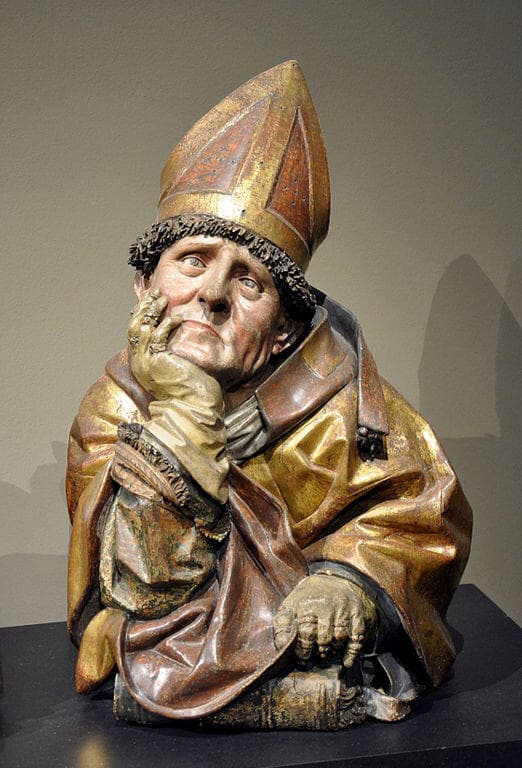
Augustine of Hippo
Catena Aurea · Lukasevangelium 10
But he, willing to justify himself, said unto Jesus, And who is my neighbour? And Jesus answering said, A certain man went down from Jerusalem to Jericho, and fell among thieves, which stripped him of his raiment, and wounded him, and departed, leaving him half dead. And by chance there came down a certain Priest that way: and when he saw him, he passed by on the other side. And likewise a Levite, when he was at the place, came and looked on him, and passed by on the other side. But a certain Samaritan, as he journeyed, came where he was; and when he saw him, he had compassion on him, And went to him, and bound up his wounds, pouring in oil and wine, and set him on his own beast, and brought him to an inn, and took care of him. And on the morrow when he departed, he took out two pence, and gave them to the host, and said unto him, Take care of him; and whatsoever thou spendest more, when I come again, I will repay thee. Which now of these three, thinkest thou, was neighbour unto him that fell among the thieves? Aud he said, He that shewed mercy on him. Then said Jesus unto him, Go, and do thou likewise.
(de. Doc. Chris. lib. i. c. 30.) Hereby we understand that he is our neighbour, to whomsoever we must shew the duty of compassion, if he need it, or would have shewn if he had needed it. From which it follows, that even he who must in his turn shew us this duty, is our neighbour. For the name of neighbour has relation to something else, nor can any one be a neighbour, save to a neighbour; but that no one is excluded to whom the office of mercy is to be denied, is plain to all; as our Lord says, Do good to them that hate you. (Matt. 5:44.) Hence it is clear, that in this command by which we are bid to love our neighbour, the holy angels are included, by whom such great offices of mercy are bestowed upon us. Therefore our Lord Himself wished also to be called our neighbour, representing Himself to have assisted the half dead man who lay in the way.