
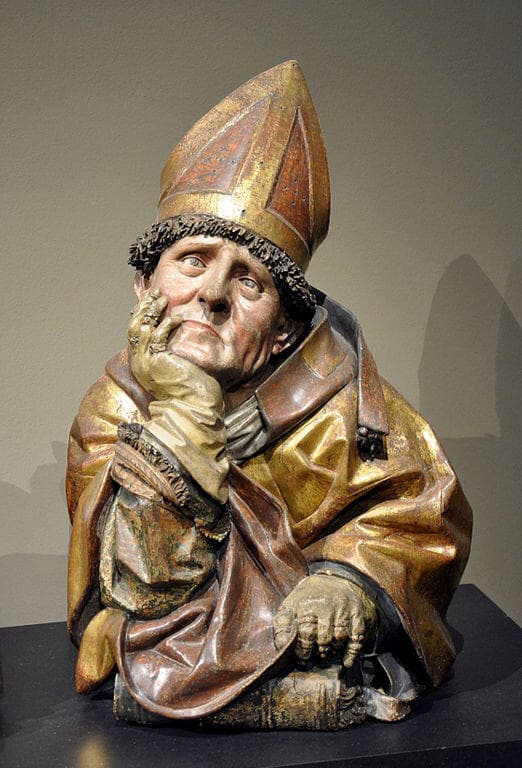
Augustine of Hippo
Catena Aurea · Lukasevangelium 1
And Mary arose in those days, and went into the hill country with haste, into a city of Juda; And entered into the house of Zacharias, and saluted Elisabeth. And it came to pass, that, when Elisabeth heard the salutation of Mary, the babe leaped in her womb; and Elisabeth was filled with the Holy Ghost: And she spake out with a loud voice, and said, Blessed art thou among women, and blessed is the fruit of thy womb. And whence is this to me, that the mother of my Lord should come to me? For, lo, as soon as the voice of thy salutation sounded in my ears, the babe leaped in my womb for joy. And blessed is she that believed: for there shall be a performance of those things which were told her from the Lord.
(Epist. ad Dardanum 57.) But in order to say this, as the Evangelist has premised, she was filled with the Holy Spirit, by whose revelation undoubtedly she knew what that leaping of the child meant; lamely, that the mother of Him had come unto her, whose forerunner and herald that child was to be. Suchthen night be the meaning of so great an event; to be known indeed by grown up persons, but not understood by a little child; for she said not, “The babe leaped in faith in my womb,” but leaped for joy. Now we see not only children leaping for joy, but even the cattle; not surely from any faith or religious feeling, or any rational knowledge. But this joy was strange and unwonted, for it was in the womb; and at the coming of her who was to bring forth the Saviour of the world. This joy, therefore, and as it were reciprocal salutation to the mother of the Lord, was caused (as miracles are) by Divine influences in the child, not in any human way by him. For even supposing the exercise of reason and the will had been so far advanced in that child, as that he should be able in the bowels of his mother to know, believe, and assent; yet surely that must be placed among the miracles of Divine power, not referred to human examples.