
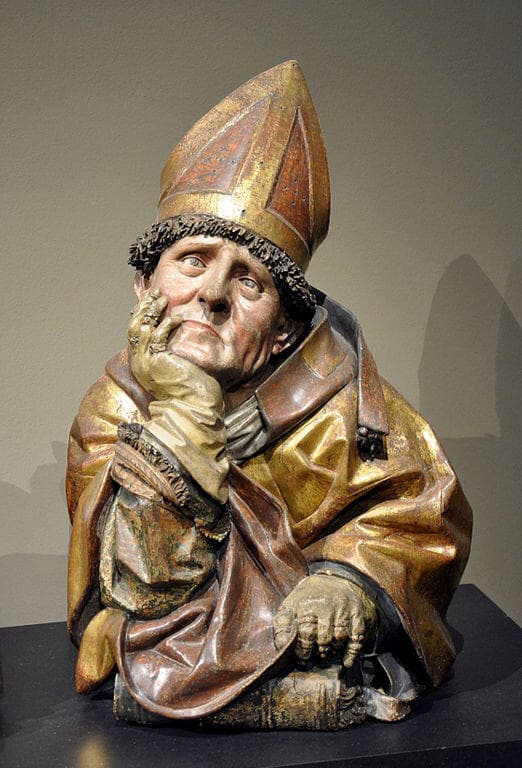
Augustine of Hippo
Catena Aurea · Johannesevangelium 6
After these things Jesus went over the sea of Galilee, which is the sea of Tiberias. And a great multitude followed him, because they saw his miracles which he did on them that were diseased. And Jesus went up into a mountain, and there he sat with his disciples. And the Passover, a feast of the Jews, was nigh. When Jesus then lifted up his eyes, and saw a great company come unto him, he saith unto Philip, Whence shall we buy bread, that these may cat? And this he said to prove him: for he himself knew what he would do. Philip answered him, Two hundred pennyworth of bread is not sufficient for them, that every one of them may take a little. One of his disciples, Andrew, Simon Peter’s brother, saith unto him, There is a lad here, which hath five barley loaves, and two small fishes: but what are they among so many? And Jesus said, Make the men sit down. Now there was much grass in the place. So the men sat down, in number about five thousand. And Jesus took the loaves; and when he had given thanks, he distributed to the disciples, and the disciples to them that were set down; and likewise of the fishes as much as they would. When they were filled, he said unto his disciples, Gather up the fragments that remain, that nothing be lost. Therefore they gathered them together, and filled twelve baskets with the fragments of the five barley loaves, which remained over and above unto them that had eaten. Then those men, when they had seen the miracle that Jesus did, said, This is of a truth that Prophet that should come into the world.
(de verb. Dom. Serm. 17) One kind of temptation leads to sin, with which God never tempts any one; (James 1:13.) and there is another kind by which faith is tried. (Deut. 13:3.) In this sense it is said that Christ proved His disciple. This is not meant to imply that He did not know what Philip would say; but is an accommodation to men’s way of speaking. For as the expression, Who searcheth the hearts of men, does not mean the searching of ignorance, but of absolute knowledge; so here, when it is said that our Lord proved Philip, we must understand that He knew him perfectly, but that He tried him, in order to confirm his faith. The Evangelist himself guards against the mistake which this imperfect mode of speaking might occasion, by adding, For He Himself knew what He would do.