
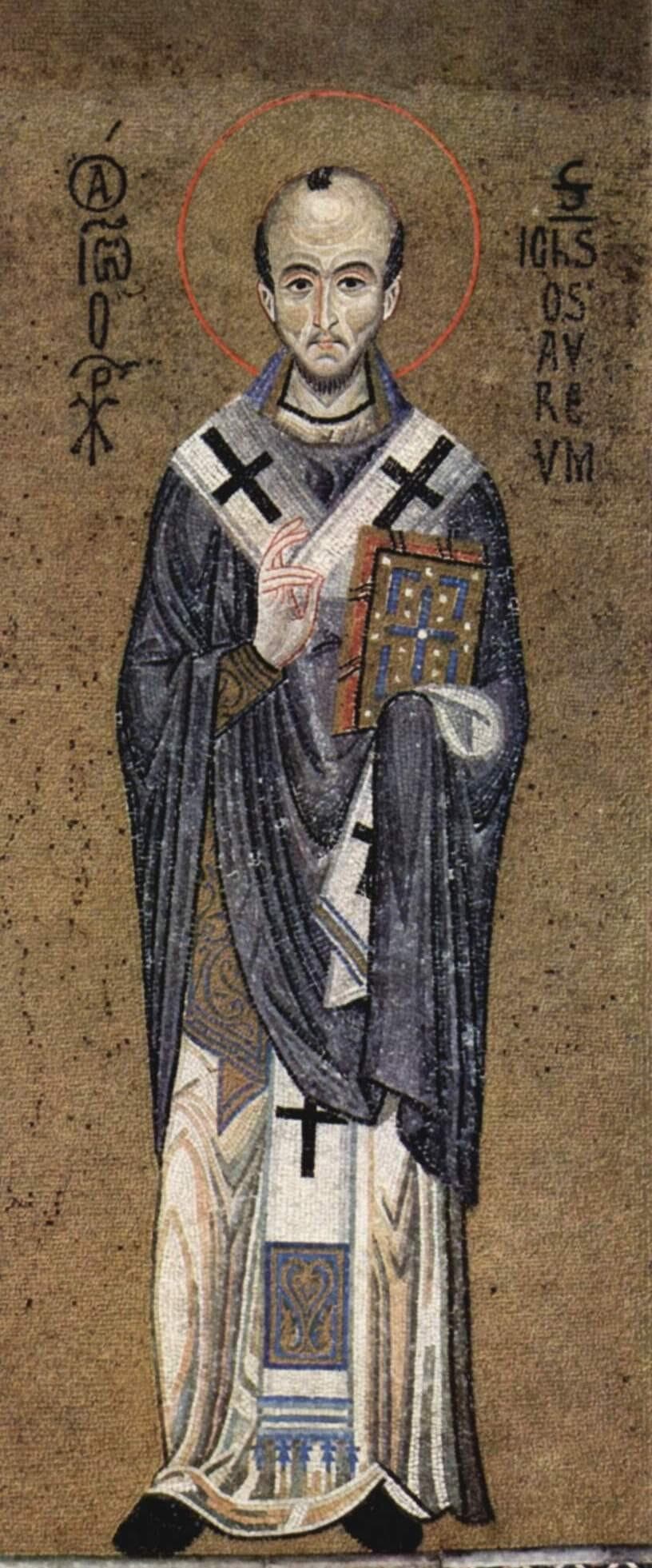
John Chrysostom
Catena Aurea · Johannesevangelium 6
After these things Jesus went over the sea of Galilee, which is the sea of Tiberias. And a great multitude followed him, because they saw his miracles which he did on them that were diseased. And Jesus went up into a mountain, and there he sat with his disciples. And the Passover, a feast of the Jews, was nigh. When Jesus then lifted up his eyes, and saw a great company come unto him, he saith unto Philip, Whence shall we buy bread, that these may cat? And this he said to prove him: for he himself knew what he would do. Philip answered him, Two hundred pennyworth of bread is not sufficient for them, that every one of them may take a little. One of his disciples, Andrew, Simon Peter’s brother, saith unto him, There is a lad here, which hath five barley loaves, and two small fishes: but what are they among so many? And Jesus said, Make the men sit down. Now there was much grass in the place. So the men sat down, in number about five thousand. And Jesus took the loaves; and when he had given thanks, he distributed to the disciples, and the disciples to them that were set down; and likewise of the fishes as much as they would. When they were filled, he said unto his disciples, Gather up the fragments that remain, that nothing be lost. Therefore they gathered them together, and filled twelve baskets with the fragments of the five barley loaves, which remained over and above unto them that had eaten. Then those men, when they had seen the miracle that Jesus did, said, This is of a truth that Prophet that should come into the world.
(Hom. xlii. 1) Though favoured with such teaching, they were influenced less by it, than by the miracles; a sign of their low state of belief: for Paul says of tongues, that they are for a sign, not to them that believe, but to them that believe not. (1 Cor. 14:22) They were wiser of whom it is said, that they were astonished at His doctrine. (Matt. 7:28) The Evangelist does not say what miracles He wrought, the great object of his book being to give our Lord’s discourses. It follows: And Jesus went up into a mountain, and there sat with His disciples. He went up into the mountain, on account of the miracle which was going to be done. That the disciples alone ascended with Him, implies that the people who stayed behind were in fault for not following. He went up to the mountain too, as a lesson to us to retire from the tumult and confusion of the world, and leave wisdom in solitude. And the passover, a feast of the Jews, was nigh. Observe, in a whole year, the Evangelist has told us of no miracles of Christ, except His healing the impotent man, and the nobleman’s son. His object was to give not a regular history, but only a few of the principal acts of our Lord. But why did not our Lord go up to the feast? He was taking occasion, from the wickedness of the Jews, gradually to abolish the Law.