
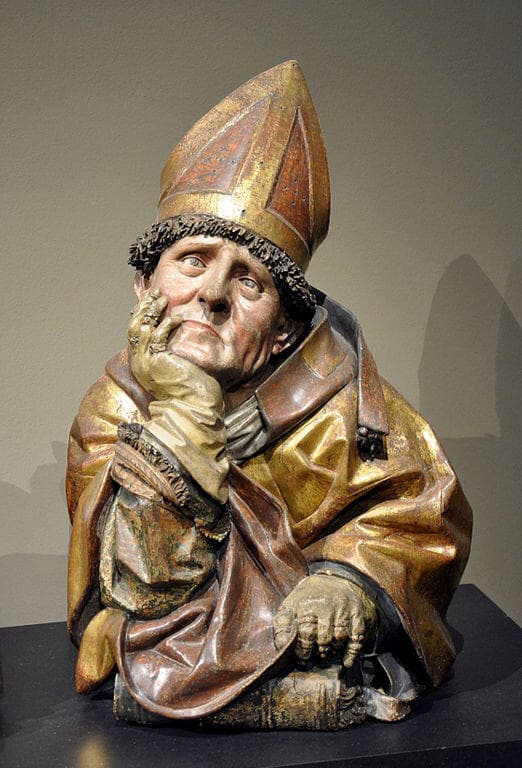
Augustine of Hippo
Catena Aurea · Johannesevangelium 5
Afterward Jesus findeth him in the temple, and said unto him, Behold, thou art made whole: sin no more, lest a worse thing come unto thee. The man departed, and told the Jews that it was Jesus, which had made him whole. And therefore did the Jews persecute Jesus, and sought to slay him, because he had done these things on the sabbath day. But Jesus answered them, My Father worketh hitherto, and I work. Therefore the Jews sought the more to kill him, because he not only had broken the sabbath, but said also that God was his Father, making himself equal with God. And (He) said unto him, Behold, thou art made whole; sin no more, lest a worse thing come upon thee.
(iv. Gen. ad lit. c. xi.) The mystery of which rest the Lord Jesus Himself scaled by His burial: for He rested in His sepulchre on the sabbath, having on the sixth day finished all His work, inasmuch as He said, It is finished. (c. 19) What wonder then that God, to prefigure the day on which Christ was to rest in the grave, rested one day from His works, afterwards to carry on the work of governing the world. We may consider too that God, when He rested, rested from the work of creation simply, i. e. made no more new kinds of creatures: but that from that time till now, He has been carrying on the government of those creatures. For His power, as respects the government of heaven and earth, and all the things that He had made, did not cease on the seventh day: they would have perished immediately, without His government: because the power of the Creator is that on which the existence of every creature depends. If it ceased to govern, every species of creation would cease to exist: and all nature would go to nothing. For the world is not like a building, which stands after the architect has left it; it could not stand the twinkling of an eye, if God withdrew His governing hand. Therefore when our Lord says, My Father worketh hitherto, he means the continuation of the work; the holding together, and governing of the creation. It might have been different, had He said, Worketh even now. This would not have conveyed the sense of continuing. As it is we find it, Until now; i. e. from the time of the creation downwards.