
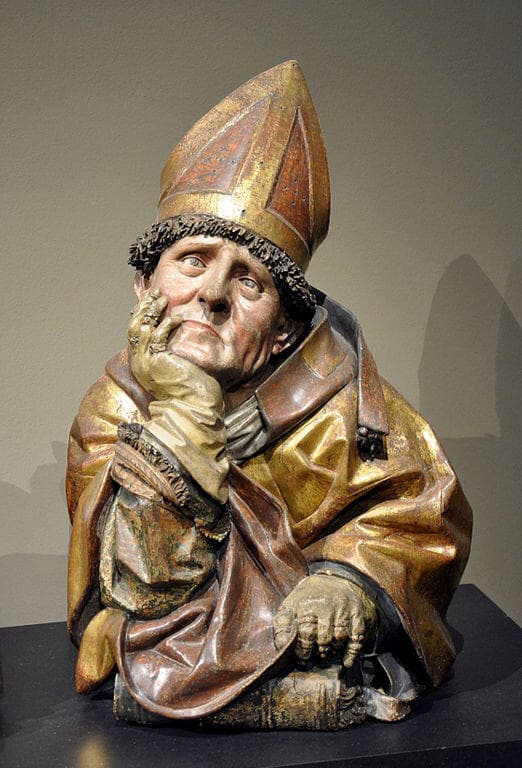
Augustine of Hippo
Catena Aurea · Johannesevangelium 5
After this there was a feast of the Jews; and Jesus went up to Jerusalem. Now there is at Jerusalem by the sheep market a pool, which is called in the Hebrew tongue Bethesda, having five porches. In these lay a great multitude of impotent folk, of blind, halt, withered, waiting for the moving of the water. For an angel went down at a certain season into the pool, and troubled the water: whosoever then first after the troubling of the water stepped in, was made whole of whatsoever disease he had. And a certain man was there, which had an infirmity thirty and eight years. When Jesus saw him lie, and knew that he had been now a long time in that case, he saith unto him, Wilt thou be made whole? The impotent man answered him, Sir, I have no man, when the water is troubled, to put me into the pool: but while I am coming, another steppeth down before me. Jesus saith unto him, Rise, take up thy bed, and walk. And immediately the man was made whole, and took up his bed, and walked: and on the same day was the sabbath. The Jews therefore said unto him that was cured, It is the sabbath day: it is not lawful for thee to carry thy bed. He answered them, He that made me whole, the same said unto me, Take up thy bed, and walk. Then asked they him, What man is that which said unto thee, Take up thy bed, and walk? And he that was healed wist not who it was: for Jesus had conveyed himself away, a multitude being in that place. Now there is at Jerusalem by the sheep-market a pool, which is called in the Hebrew tongue Bethesda, having five porches.
(Tr. xvii. c. 3) So then Christ came to the Jewish people, and by means of mighty works, and profitable lessons, troubled the sinners, i. e. the water, and the stirring continued till He brought on His own passion. But He troubled the water, unknown to the world. For had they known Him, they would not have crucified the Lord of glory. (1 Cor. 11) But the troubling of the water came on all at once, and it was not seen who troubled it. Again, to go down into the troubled water, is to believe humbly on our Lord’s passion. Only one was healed, to signify the unity of the Church: whoever came afterwards was not healed, to signify that whoever is out of this unity cannot be healed. Wo to them who hate unity, and raise sects. Again, he who was healed had had his infirmity thirty and eight years: this being a number which belongs to sickness, rather than to health. The number forty has a sacred character with us, and is significative of perfection. For the Law was given in Ten Commandments, and was to be preached throughout the whole world, which consists of four parts; and four multiplied into ten, make up the number forty. And the Law too is fulfilled by the Gospel, which is written in four books. So then if the number forty possesses the perfectness of the Law, and nothing fulfils the Law, except the twofold precept of love, why wonder at the impotence of him, who was two less than forty? Some man was necessary for his recovery; but it was a man who was God. He found the man falling short by the number two, and therefore gave two commandments, to fill up the deficiency. For the two precepts of our Lord signify love; the love of God being first in order of command, the love of our neighbour, in order of performance. Take up thy bed, ourLord saith, meaning, When thou wert impotent, thy neighbour carried thee; now thou art made whole, carry thy neighbour. And walk; but whither, except to the Lord thy God.