
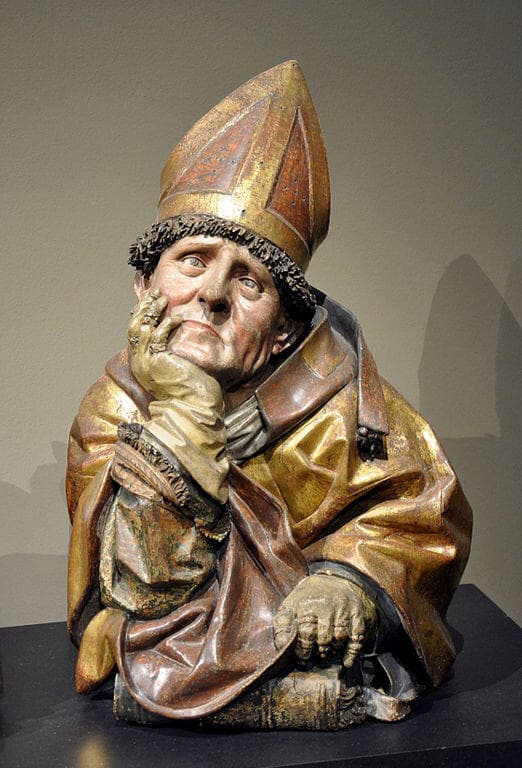
Augustine of Hippo
Catena Aurea · Johannesevangelium 4
Jesus answered and said unto her, Whosoever drinketh of this water shall thirst again: But whosoever drinketh of the water that I shall give him shall never thirst; but the water that I shall give him shall be in him a well of water springing up into everlasting life. The woman saith unto him, Sir, give me this water, that I thirst not, neither come hither to draw. Jesus saith unto her, Go, call thy husband, and come hither. The woman answered and said, I have no husband. Jesus said unto her, Thou hast well said, I have no husband: For thou hast had five husbands; and he whom thou now hast is not thy husband: in that saidst thou truly.
(Tr. xv. c. 19) Jesus seeing that the woman did not understand, and wishing to enlighten her, says, Call thy husband; i. e. apply thine understanding. For when the life is well ordered, the understanding governs the soul itself, pertaining to the soul. For though it is indeed nothing else than the soul, it is at the same time a certain part of the soul. And this very part of the soul which is called the understanding and the intellect, is itself illuminated by a light superior to itself. Such a Light was talking with the woman; but in her there was not understanding to be enlightened. Our Lord then, as it were, says, I wish to enlighten, and there is not one to be enlightened; Call thy husband, i. e. apply thine understanding, through which thou must be taught, by which governed. The five former husbands may be explained as the five senses,thus: a man before he has the use of his reason, is entirely under the government of his bodily senses. Then reason comes into action; and from that time forward he is capable of entertaining ideas, and is either under the influence of truth or error. The woman had been under the influence of error, which error was not her lawful husband, but an adulterer. Wherefore our Lord says, Put away that adulterer which corrupts thee, and call thy husband, that thou mayest understand Me.