
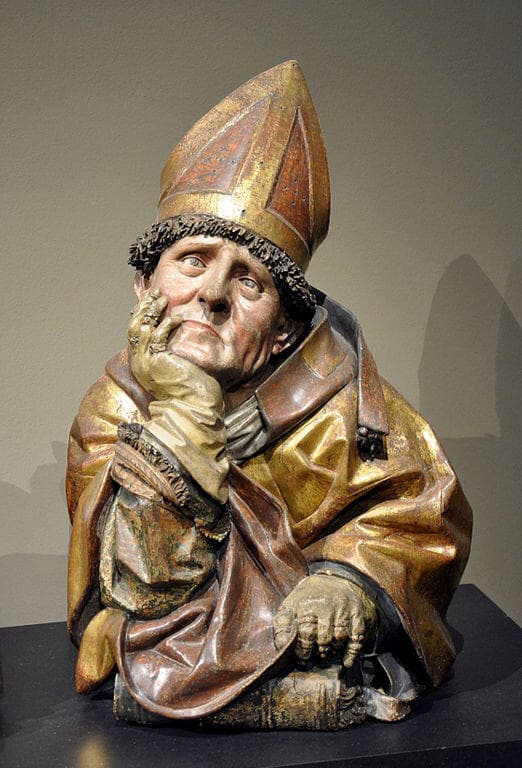
Augustine of Hippo
Catena Aurea · Johannesevangelium 4
When therefore the Lord knew how the Pharisees had heard that Jesus made and baptized more disciples than John, (Though Jesus himself baptized not, but his disciples,) He left Judæa, and departed again into Galilee. And he must needs go through Samaria. Then cometh he to a city of Samaria, which is called Sychar, near to the parcel of ground that Jacob gave to his son Joseph. Now Jacob’s well was there. Jesus therefore, being wearied with his journey, sat thus on the well: and it was about the sixth hour. Now Jacob’s well was there.
(1. lxxxiii. Quæst. qu. 64) At the sixth hour then our Lord comes to the well. The black abyss of the well, methinks, represents the lowest parts of this universe, i. e. the earth, to which Jesus came at thesixth hour, that is, in the sixth age of mankind, the old age, as it were, of the old man, which we are bidden to put off, (Col. 3:9.) that we may put on the new. For so do we reckon the different ages of man’s life: the first age is infancy, the second childhood, the third boyhood, the fourth youth, the fifth manhood, the sixth old age. Again, the sixth hour, being the middle of the day, the time at which the sun begins to descend, signifies that we, who are called by Christ, are to check our pleasure in visible things, that by the love of things invisible refreshing the inner man, we may be restored to the inward light which never fails. By His sitting is signified His humility, or perhaps His magisterial character; teachers being accustomed to sit.