
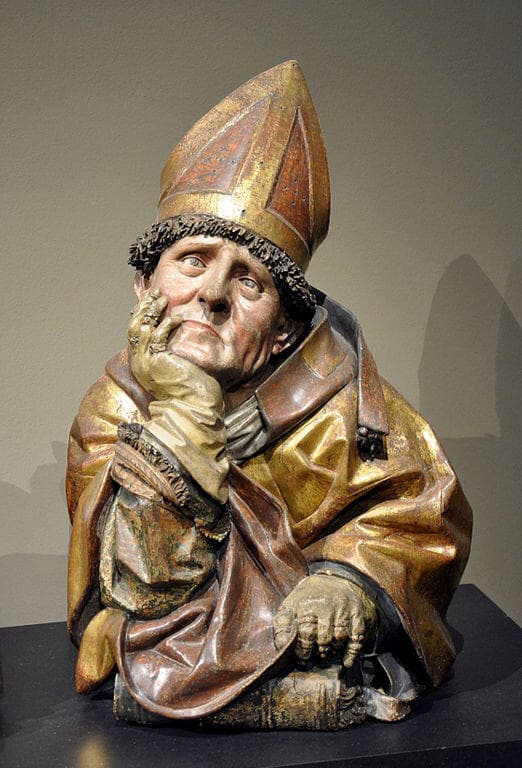
Augustine of Hippo
Catena Aurea · Johannesevangelium 20
Then the disciples went away again unto their own home. But Mary stood without at the sepulchre weeping: and as she wept, she stooped down, and looked into the sepulchre, And seeth two angels in white sitting, the one at the head, and the other at the feet, where the body of Jesus had lain. And they say unto her, Woman, why weepest thou? She saith unto them, Because they have taken away my Lord, and I know not where they have laid him. And when she had thus said, she turned herself back, and saw Jesus standing, and knew not that it was Jesus. Jesus saith unto her, Woman, why weepest thou? whom seekest thou? She, supposing him to be the gardener, saith unto him, Sir, if thou have borne him hence, tell me where thou hast laid him, and I will take him away. Jesus saith unto her, Mary. She turned, herself, and saith unto him, Rabboni; which is to say, Master. Jesus saith unto her, Touch me not; for I am not yet ascended to my Father: but go to my brethren, and say unto them, I ascend unto my Father, and your Father; and to my God, and your God. Mary Magdalene came and told the disciples that she had seen the Lord, and that he had spoken these things unto her.
(Tr. cxxi. 3) But if standing upon the earth, He is not touched, how shall He be touched sitting in heaven? And did He not before His ascension offer Himself to the touch of the disciples: Handle Me and see, for a spirit hath not flesh and bones? (Luke 24:39) Who can be so absurd as to suppose that He was willing that disciples should touch Him before He ascended to His Father, and unwilling that women should till after? Nay, we read of women after the resurrection, and before He ascended to His Father, touching Him, one of whom was Mary Magdalene herself, according to Matthew. Either then Mary here is a type of the Gentile Church, which did not believe in Christ till after His ascension: or the meaning is that Jesus is to be believed in, i. e. spiritually touched, in no other way, but as being one with the Father. He ascends to the Father mystically, as it were, in the mind of him who hath so far advanced as to acknowledge that He is equal to the Father. But how could Mary believe in Him otherwise than carnally, when she wept for Him as a man?