
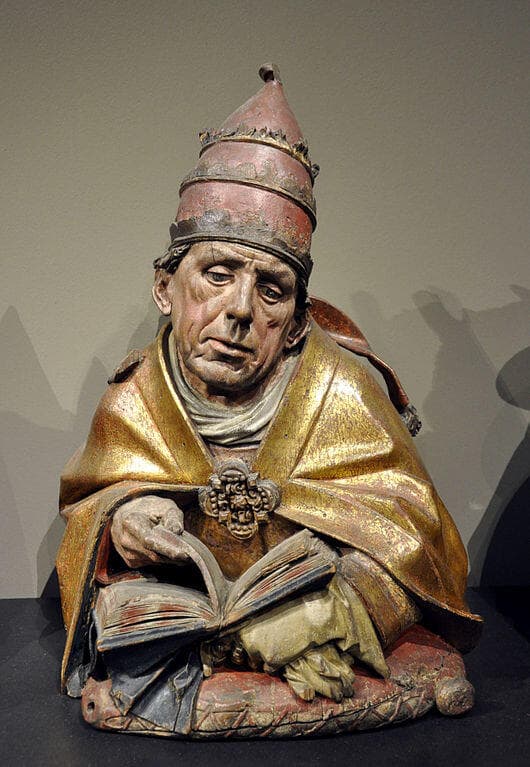
Gregory the Great
Catena Aurea · Johannesevangelium 20
The first day of the week cometh Mary Magdalene early, when it was yet dark, unto the sepulchre, and seeth the stone taken away from the sepulchre. Then she runneth, and cometh to Simon Peter, and to the other disciple, whom Jesus loved, and saith unto them, They have taken away the Lord out of the sepulchre, and we know not where they have laid him. Peter therefore went forth, and that other disciple, and came to the sepulchre. So they ran both together: and the other disciple did outrun Peter, and came first to the sepulchre. And he stooping down, and looking in, saw the linen clothes lying: yet went he not in. Then cometh Simon Peter following him, and went into the sepulchre, and seeing the linen clothes lie, And the napkin, that was about his head, not lying with the linen clothes, but wrapped together in a place by itself. Then went in also that other disciple, which came first to the sepulchre, and he saw, and believed. For as yet they knew not the Scripture, that he must rise again from the dead. And seeth the stone taken away from the sepulchre.
(Hom. xxii. in Evang.) But this account of the Evangelist1 must not be thought to be without some mystical meaning. By John, the younger of the two, the synagogue; by Peter, the elder, the Gentile Church is represented: for though the synagogue was before the Gentile Church as regards the worship of God, as regards time the Gentile world was before the synagogue. They ran together, because the Gentile world ran side by side with the synagogue from first to last, in respect of purity and community of life, though a purity and community of understanding2 they had not. The synagogue came first to the sepulchre, but entered not: it knew the commandments of the law, and had heard the prophecies of our Lord’s incarnation and death, but would not believe in Him who died. Then cometh Simon Peter, and enteredinto the sepulchre: the Gentile Church both knew Jesus Christ as dead man, and believed in Him as living God. The napkin about our Lord’s head is not found with the linen clothes, i. e. God, the Head of Christ, and the incomprehensible mysteries of the Godhead are removed from our poor knowledge; His power transcends the nature of the creature. And it is found not only apart, but also wrapped together; because of the linen wrapped together, neither beginning nor end is seen; and the height of the Divine nature had neither beginning nor end. And it is into one place: for where there is division, God is not; and they merit His grace, who do not occasion scandal by dividing themselves into sects. But as a napkin is what is used in labouring to wipe the sweat of the brow, by the napkin here we may understand the labour of God: which napkin is found apart, because the suffering of our Redeemer is far removed from ours; inasmuch as He suffered innocently, that which we suffer justly; He submitted Himself to death voluntarily, we by necessity. But after Peter entered, John entered too; for at the end of the world even Judæa shall be gathered in to the true faith.