
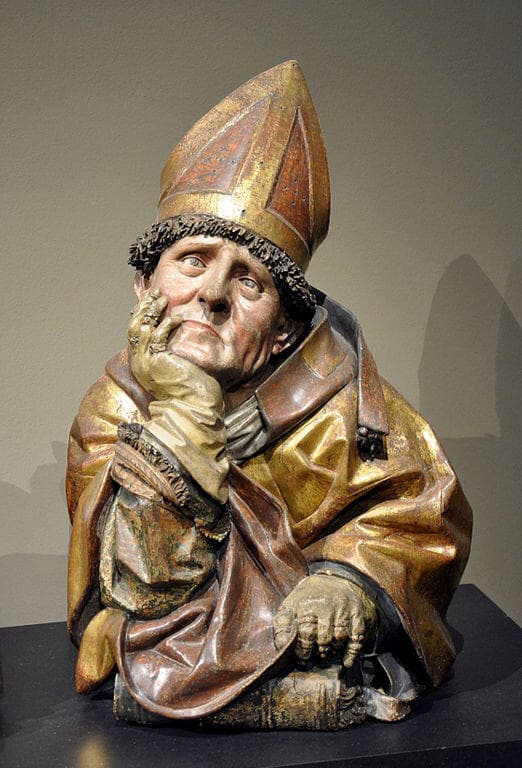
Augustine of Hippo
Catena Aurea · Johannesevangelium 2
His mother saith unto the servants, Whatsoever he saith unto you, do it. And there were set there six waterpots of stone, after the manner of the purifying of the Jews, containing two or three firkins apiece. Jesus saith unto them, Fill the waterpots with water. And they filled them up to the brim. And he saith unto them, Draw out now, and bear unto the governor of the feast. And they bare it. When the ruler of the feast had tasted the water that was made wine, and knew not whence it was: (but the servants which drew the water knew;) the governor of the feast called the bridegroom, And saith unto him, Every man at the beginning doth set forth good wine; and when men have well drunk, then that which is worse: but thou hast kept the good wine until now. This beginning of miracles did Jesus in Cana of Galilee, and manifested forth his glory; and his disciples believed on him. Jesus saith unto them, Fill the waterpots with water. And they filled them up to the brim.
(Tr. ix. 5. et sq.) Now if He ordered the water to be poured out, and then introduced the wine from the hidden recesses1 of creation, He would seem to have rejected the Old Testament. But converting, as He did, the water into wine, He shewed us that the Old Testament was from Himself, for it was by His order that the waterpots were filled. But those Scriptures have no meaning, if Christ be not understood there. Now we know from what time the law dates, viz. from the foundation of the world. From that time to this are six ages; the first, reekoning from Adam to Noah; the second, from Noah to Abraham; the third, from Abraham to David; the fourth, from David to the carrying away into Babylon; the fifth, from that time to John the Baptist; the sixth, from John the Baptist to the end of the world. The six waterpots then denote these six ages of prophecy. The prophecies are fulfilled; the waterpots are full. But what is the meaning of their holding two or three firkins apiece? Had He said three only, our minds would have run immediately to the mystery of the Trinity. Nor perhaps can we reject it, even though it is said, two or three: for the Father and the Son being named, the Holy Ghost may be understood by consequence; inasmuch as it is the love between the Father and the Son, which is the Holy Ghost. (c. 17.). Nor should we pass over another interpretation, which makes the two firkins alluded to the two races of men, the Jews and the Greeks; and the three to the three sons of Noah.