
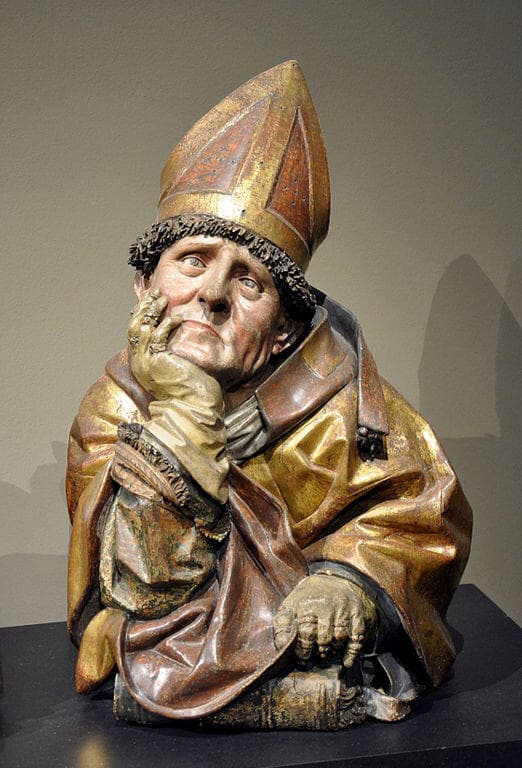
Augustine of Hippo
Catena Aurea · Johannesevangelium 19
Then the soldiers, when they had crucified Jesus, took his garments, and made four parts, to every soldier a part; and also his coat: now the coat was without seam, woven from the top throughout. They said therefore among themselves, Let us not rend it, but cast lots for it, whose it shall be: that the Scripture might be fulfilled, which saith, They parted my raiment among them, and for my vesture they did cast lots. On Pilate giving sentence, the soldiers under his command crucified Jesus: Then the soldiers, when they had crucified Jesus, took His garments. And yet if we look to their intentions, their clamours, the Jews were rather the people which crucified Him. On the parting and casting lots for His garment, John gives more circumstances than the other Evangelists, And made four parts, to every soldier a part: whence we see there were four soldiers who executed the governor’s sentence. And also His coat: took, understood. They took His coat too. The sentence is brought in so to shew that this was the only garment for which they cast lots, the others being divided. Now the coat was without seam, woven from the top throughout.
(Tract. cxviii) Nor let any one say that these things had no good signification, because they were done by wicked men; for if so, what shall we say of the cross itself? For that was made by ungodly men, and yet certainly by it were signified, What is the length, and depth, and breadth, and height, (Eph. 3:18) as the Apostle saith. Its breadth consists of a cross beam, on which are stretched the hands of Him who hangs upon it. This signifies the breadth of charity, and the good works done therein. Its length consists of a cross beam going to the ground, and signifies perseverance in length of time. The height is the top which rises above the cross beam, and signifies the high end to which all things refer. The depth is that part which is fixed in the ground; there it is hidden, but the whole cross that we see rises from it. Even so all our good works proceed from the depth of God’s incomprehensible grace. But though the cross of Christ only signify what the Apostle saith, They that are Christ’s have crucified the flesh, with the affections and lusts, (Gal. 5:24) how great a good is it? Lastly, what is the sign of Christ, but the cross of Christ? Which sign must be applied to the foreheads of believers, to the water of regeneration, to the oil of chrism, to the sacrifice whereby we are nourished, or none of these is profitable for life.