
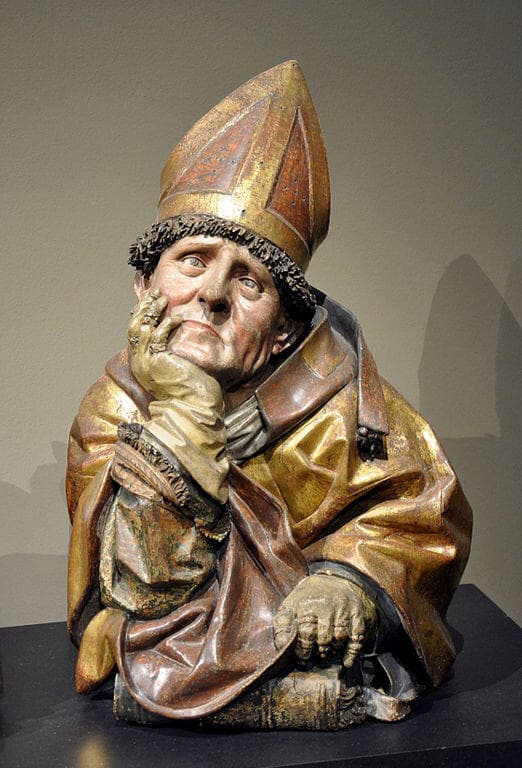
Augustine of Hippo
Catena Aurea · Johannesevangelium 19
Then the soldiers, when they had crucified Jesus, took his garments, and made four parts, to every soldier a part; and also his coat: now the coat was without seam, woven from the top throughout. They said therefore among themselves, Let us not rend it, but cast lots for it, whose it shall be: that the Scripture might be fulfilled, which saith, They parted my raiment among them, and for my vesture they did cast lots. On Pilate giving sentence, the soldiers under his command crucified Jesus: Then the soldiers, when they had crucified Jesus, took His garments. And yet if we look to their intentions, their clamours, the Jews were rather the people which crucified Him. On the parting and casting lots for His garment, John gives more circumstances than the other Evangelists, And made four parts, to every soldier a part: whence we see there were four soldiers who executed the governor’s sentence. And also His coat: took, understood. They took His coat too. The sentence is brought in so to shew that this was the only garment for which they cast lots, the others being divided. Now the coat was without seam, woven from the top throughout.
(Tract. cxviii. 3) Matthew in saying, They parted His garments, casting lots, (Mat. 27:35.) means us to understand the whole division of the garments, including the tunic also for which they cast lots. Luke says the same: They parted His raiment, and cast lots. (Luke 23:34) In parting His garments they came to the tunic, for which they cast lots. Mark is the only one that raises any question: They parted His garments, casting upon them what every man should take: (Mark 15:24) as if they cast lots for all the garments, and not the tunic only. But it is his brevity that creates the difficulty. Casting lots upon them: as if it was, casting lots when they were parting the garments. What every man should take: i. e. who should take the tunic; as if the whole stood thus: Casting lots upon them, who should take the tunic which remained over and above the equal shares, into which the rest of the garments were divided. The fourfold division of our Lord’s garment represents His Church, spread over the four quarters of the globe, and distributed equally, i. e. in concord, to all. The tunic for which they cast lots signifies the unity of all the parts, which is contained in the bond of love. And if love is the more excellent way, above knowledge, and above all other commandments, according to Colossians, Above all things have charity, (Col. 3:14) the garment by which this is denoted, is well said to be woven from above. (desuper, ἄνωθεν) Through the whole, is added, because no one is void of it, who belongs to that whole, from which the Church Catholic is named. It is without seam again, so that it can never come unsown, and is in one piece, i. e. brings all together into one. (ad unum provenit) By the lot is signified the grace of God: for God elects not with respect to person or merits, but according to His own secret counsel.