
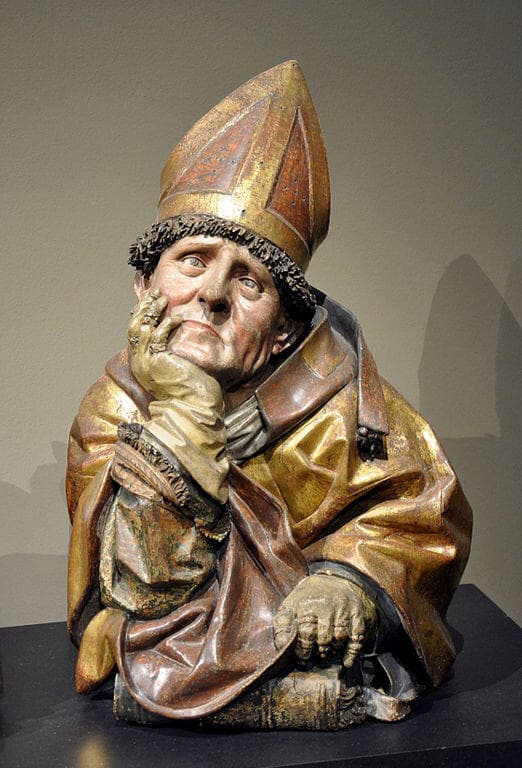
Augustine of Hippo
Catena Aurea · Johannesevangelium 16
And in that day ye shall ask me nothing. Verily, verily, I say unto you, Whatsoever ye shall ask the Father in my name, he will give it you. Hitherto have ye asked nothing in my name: ask, and ye shall receive, that your joy may be full. These things have I spoken unto you in proverbs: but the time cometh, when I shall no more speak unto you in proverbs, but I shall shew you plainly of the Father. At that day ye shall ask in my name: and I say not unto you, that I will pray the Father for you: For the Father himself loveth you, because ye have loved me, and have believed that I came out from God. I came forth from the Father, and am come into the world: again, I leave the world, and go to the Father.
(Tr. cii. c. 3) But this sense seems to be interfered with by what follows: At that day ye shall ask in My name. What shall we have to ask for in a future life, when all our desires shall be satisfied? Asking implies the want of something. It remains then that we understand the words of Jesus going to make His disciples spiritual, from being carnal and natural beings. The natural man so understands whatever he hears of God in a bodily sense, as being unable to conceive any other. Wherefore whatever Wisdom saith of the incorporeal, immutable substance are proverbs to him, not that he accounts them proverbs, but understands them as if they were proverbs. But when, become spiritual, he hath begun to discern all things, though in this life he see but in a glass and in part, ye doth he perceive, not by bodily sense, not by idea of the imagination, but by most sure intelligence of the mind, perceive and hold that God is not body, but spirit: the Son sheweth so plainly of the Father, that He who sheweth is seen to be of the same nature with Him who is shewn. Then they who ask, ask in His name, because by the sound of that name they understand nothing but the thing itself which is expressed by that name. These are able to think that our Lord Jesus Christ, in so far as He is man, intercedes with the Father for us, in so far as He is God, hears us together with the Father: which I think is His meaning when He says, And I say not unto you that I will pray the Father for you. To understand this, viz. how that the Son does not ask the Father, but Father and Son together hear those who ask, is beyond the reach of any but the spiritual vision.