
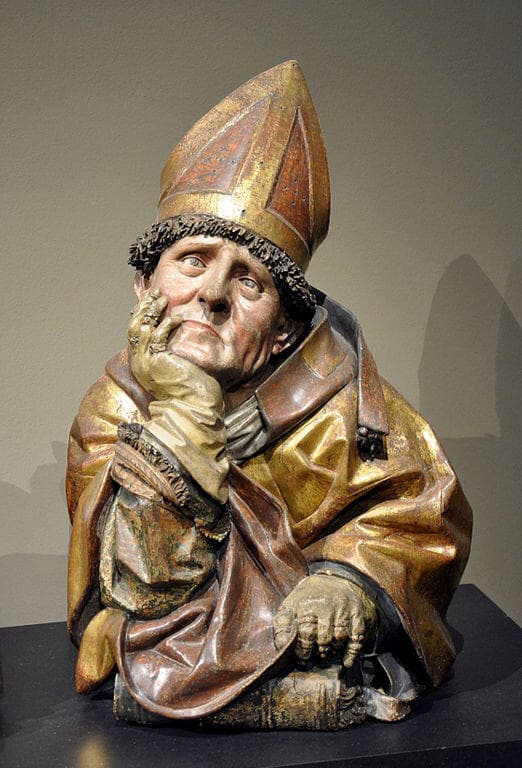
Augustine of Hippo
Catena Aurea · Johannesevangelium 14
Judas saith unto him, not Iscariot, Lord, how is it that thou wilt manifest thyself unto us, and not unto the world? Jesus answered and said unto him, If a man love me, he will keep my words: and my Father will love him, and we will come unto him, and make our abode with him. He that loveth me not keepeth not my sayings: and the word which ye hear is not mine, but the Father’s which sent me. These things have I spoken unto you, being yet present with you. But the Comforter, which is the Holy Ghost, whom the Father will send in my name, he shall teach you all things, and bring all things to your remembrance, whatsoever I have said unto you. Peace I leave with you, my peace I give unto you: not as the world giveth, give I unto you.
(Tract. lxxvii. 2) He left no peace in this world; in which we conquer the enemy, and have love one to another: He will give us peace in the world to come, when we shall reign without an enemy, and where we shall be able to avoid disagreement. This peace is Himself, both when we believe that He is, and when we shall see Him as He is. But why does He say, Peace I leave with you, without the My, whereas He puts in My in, My peace I give unto you? Are we to understand My in the former; or is it not rather left out with a meaning? His peace is such peace as He has Himself; the peace which He left us in this world is rather our peace than His. He has nothing to fight against in Himself, because He has no sin: but ours is a peace in which we still say, Forgive us our debts. (Matt. 6:12) And in like manner we have peace between ourselves, because we mutually trust one another, that we mutually love one another. But neither is that a perfect peace; for we do not see into each other’s minds. I could not deny however that these words of our Lord’s may be understood as a simple repetition. He adds, Not as the world giveth, give I unto you: i. e. not as those men, who love the world, give. They give themselves peace, i. e. free, uninterrupted enjoyment of the world. And even when they allow the righteous peace, so far as not to persecute them, yet there cannot be true peace, where there is no true agreement, no union of heart.