
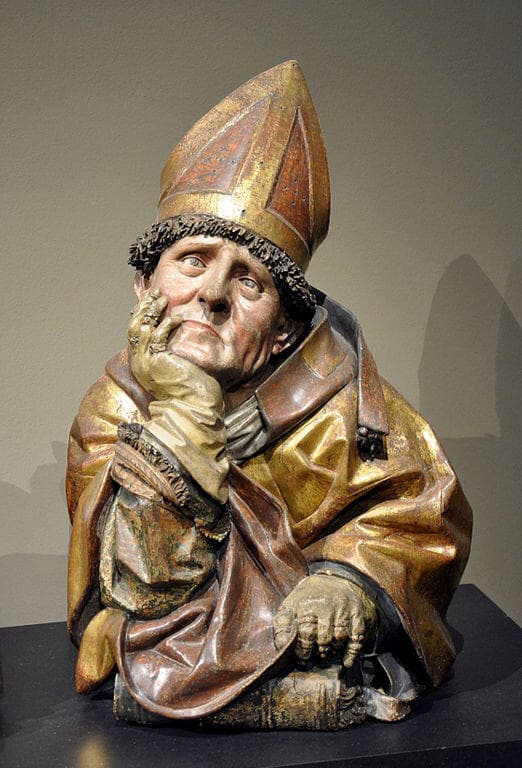
Augustine of Hippo
Catena Aurea · Johannesevangelium 13
When Jesus had thus said, he was troubled in spirit, and testified, and said, Verily, verily, I say unto you, that one of you shall betray me. Then the disciples looked one on another, doubting of whom he spake. Now there was leaning on Jesus’ bosom one of his disciples, whom Jesus loved. Simon Peter therefore beckoned to him, that he should ask who it should be of whom he spake. He then lying on Jesus’ breast saith unto him, Lord, who is it? Jesus answered, He it is, to whom I shall give a sop, when I have dipped it. And when he had dipped the sop, he gave it to Judas Iscariot, the son of Simon. And after the sop Satan entered into him. Then said Jesus unto him, That thou doest, do quickly. Now no man at the table knew for what intent he spake this unto him. For some of them thought, because Judas had the bag, that Jesus had said unto him, Buy those things that we have need of against the feast; or, that he should give something to the poor. He then having received the sop went immediately out: and it was night.
(Tr. lx. 1) This did not come into His mind’then for the first time; but He was now about to make the traitor known, and single him out from the rest, and therefore was troubled in spirit. The traitor too was now just about to go forth to execute his purpose. He was troubled at the thought of His Passion being so near at hand, at the dangers to which His faithful followers would be brought at the hand of the traitor, which were even now impending over Him. Our Lord deigned to be troubled also, to shew that false brethren cannot be cut off, even in the most urgent necessity, without the troubling of the Church. (Tr. lxi. 1.). He was troubled not in flesh, but in spirit; for on occasion of scandals of this kind, the spirit is troubled, not perversely, but in love, lest in separating the tares, some of the wheat too be plucked up with them. (Tr. lx. 5.). But whether He was troubled by pity for perishing Judas, or, by the near approach of His own death, He was troubled not through weakness of mind, but power: He was not troubled because any thing compelled Him, but He troubled Himself, as was said above. And in that He was troubled, He consoles the weak members of His body, i. e. His Church, that they may not think themselves reprobate, should they be troubled at the approach of death.