
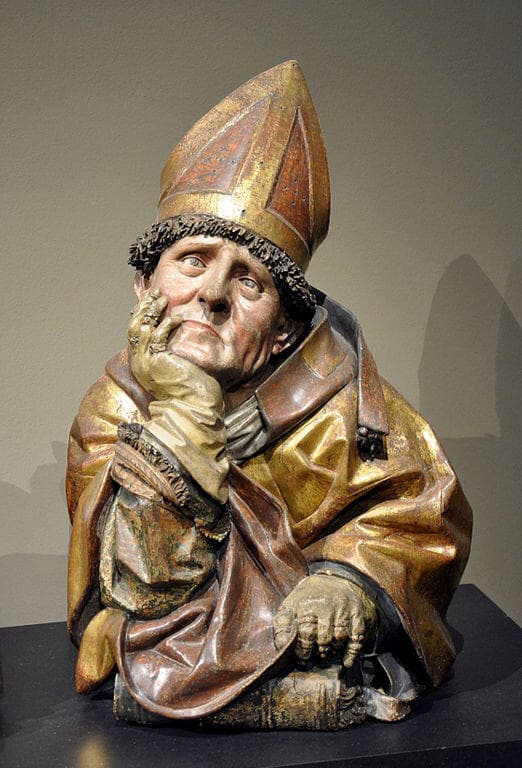
Augustine of Hippo
Catena Aurea · Johannesevangelium 13
So after he had washed their feet, and had taken his garments, and was set down again, he said unto them, Know ye what I have done to you? Ye call me Master and Lord: and ye say well; for so I am. If I then, your Lord and Master, have washed your feet; ye also ought to wash one another’s feet. For I have given you an example, that ye should do as I have done to you. Verily, verily, I say unto you, The servant is not greater than his lord: neither he that is sent greater than he that sent him. If ye know these things, happy are ye if ye do them. I speak not of you all: I know whom I have chosen: but that the Scripture may be fulfilled, He that eateth bread with me hath lifted up his heel against me. Now I tell you before it come, that, when it is come to pass, ye may believe that I am he. Verily, verily, I say unto you, He that receiveth whomsoever I send receiveth me; and he that receiveth me receiveth him that sent me. If then I your Lord and Master have washed your feet, ye also ought to wash one another’s feet. Now I tell you before it come, that when it is come, ye may believe that I am He, i. e. of whom that Scripture foretold.
(Tr. xlix. 2) The Arians, when they hear this passage, appeal immediately to the gradations in their system, that as far as the Apostle is from the Lord, so far is the Son from the Father. But our Lord hath left us no room for doubt on this head; for He saith, I and My Father are one. (supr. 10:30) But how shall we understand those words of our Lord, He that receiveth Me, receiveth Him that sent Me? If we take them to mean that the Father and the Son are of one nature, it will seem to follow, when He says, He that receiveth whomsoever I send, receiveth Me, that the Son and an Apostle are of one nature. May not the meaning be, He that receiveth whosoever I send, receiveth Me, i. e. Me as man: But He that receiveth Me, i. e. as God, receiveth Him that sent Me. But it is not this unity of nature, which is here put forth, but the authority of the Sender, as represented by Him who is sent. In Peter hear Christ, the Master of the disciple, in the Son the Father, the Begotten of the Only Begotten.